Desis play Holi in unholy weather

Standard
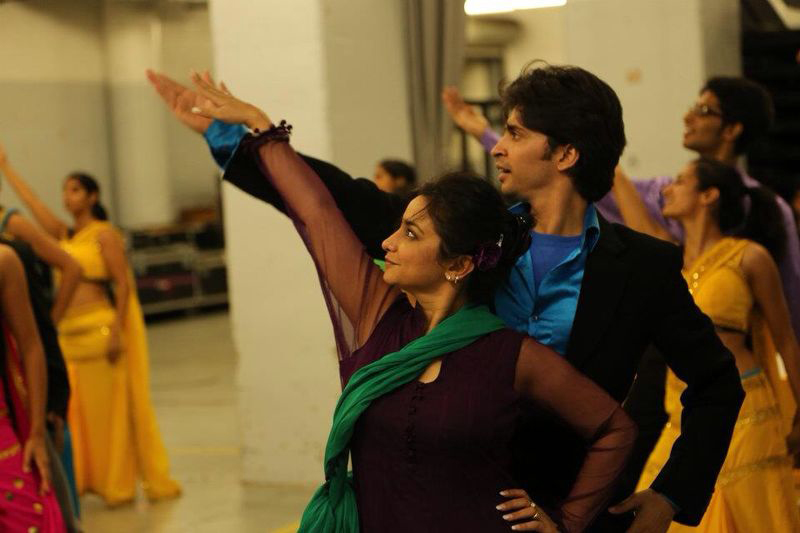
The KC Group Canada celebrated the festival of colours Holi in sub-zero temperature. Photo by Radhika Panjwani

The KC Group Canada celebrated the festival of colours Holi in sub-zero temperature.

For years now, the KC Group Canada has refused to let the Canadian winter/spring come in the way of its Holi celebrations.

Holi is a festival of colours celebrated in most parts of India at the start of spring. The colour-run  can be compared to the La Tomatina festival of Spain, except in this case, tomatoes are not harmed in the revelry. In fact, there are no fruit or vegetables involved.

For Holi, masses of people take to the streets armed with water guns and coloured powder called ‘Gulal’ which they toss at one another. In the larger scheme of things, Holi gives everyone—adults and children—a chance to bring out their inner child.

In India, the festival is played outdoors, but here in Canada, the KC Group celebrated Holi indoors inside the National Banquet Hall in Mississauga.

Also, the play of Holi was restricted to a small area on the hardwood dance floor. It sure got cramped in the space as people jostled around. One can only imagine the horror on the faces of the cleaning crew should they discover the stubborn colour stuck to the carpet, furniture and upholstery. Nevertheless, despite the obvious limitations, some 300 people let their hair down and partied as if there was no tomorrow.

The KC Group Canada has been celebrating Holi and Diwali in Canada despite the fact that the realities of weather here along with combination of city bylaws dilute the fun a bit. Also, in Canada, organizers sanitize the tradition by making it all above board.
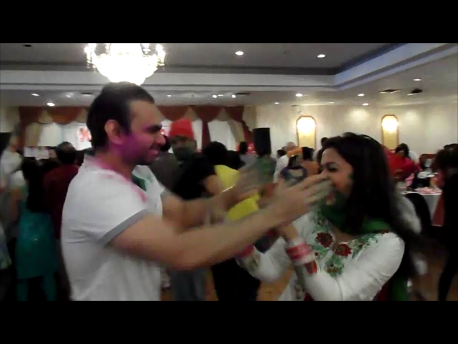
The KC Group Canada celebrated the festival of colours Holi at the National Banquet Hall in Mississauga.

The KC Group Canada celebrated the festival of colours Holi at the National Banquet Hall in Mississauga.

Let me explain, in India, one of the staples of Holi is a drink called Bhang. Now, Bhang is a drink made from the leaves and flowers of the cannabis plant. Using a mortar and pestle, people smash the leaves and flowers and grind it to a fine paste which they incorporate into a drink. It’s not uncommon—in India— to see men completely wasted on Holi and looking comical with multi-coloured hues of gulal stuck the faces, hair and clothes.

As a South Indian, I was always envious of the traditions practiced in the North. Seriously, how cool is that you can get drunk on Holi and gamble on Diwali?

Food and drink aside, Holi is about dancing. No one can sing a Holi song better than Indian’s evergreen superstar Amitabh Bachchan. His deep gravelly voice has some kind of power. When I heard his songs at the KC Group’s Holi bash, I was filled with sheer nostalgia of the past. Ah, those were the days.

Kathak in Canada would have faded into sidelines if not for Rina Singha

Standard
Toronto's Kathak legend Rina Singha, 77, will be presenting a show starting Thursday, March 20 to Saturday, March 22 at Harbourfront Centre. The show is an ode to her guru Shambu Maharaj. Supplied photo.

Toronto’s Kathak legend Rina Singha, 77, will be presenting a show starting Thursday, March 20 to Saturday, March 22 at Harbourfront Centre. The show is an ode to her guru Shambu Maharaj.
Supplied photo.

The Indian dance form of Kathak can be described as a motion of pure grace and poetry.

There’s a certain economy of space and time. To a bystander unschooled in any dance form whatsoever, the dancer’s quick movements and the music’s short staccato bursts may appear completely in tandem.

In India, religion and arts, oddly enough are interwoven. For instance, the pursuit of classical dance and singing has by and large been the domain of Hindus and to some extent the Muslims.

So, it’s fascinating that Toronto native Rina Singha, 77, has not only elevated Kathak on the world platform, but as a Christian, she has immortalized her spirituality, faith and fables into a visually compelling stories through Kathak.

In what can be described as an ode to her teacher—Guru Shambu Maharaj—Singha, and choreographer/friend Danny Grossman are presenting Circle of Bricks- Rhythms of Kathak, starting Thursday, March 20 and running until Saturday, March 22, at the Harbourfront Centre (Fleck Dance Theatre). On Thursday and Friday the show will run at 8 p.m. on Saturday, it’s at 3 p.m. Tickets cost $30/person.

When Singha arrived in Toronto from India in 1965, she brought with her, her love for a dance form that may have been dismissed as “quixotic and exotic’ in the arts scene here. Over the next five decades, she worked tirelessly to ensure her beloved Kathak was part of the mainstream art scene.

At 77, Toronto's Rina Singha remains as committed as ever to Kathak. The Toronto native has single- handedly elevated Kathak into the mainstream arts scene here in Canada. Supplied photo

At 77, Toronto’s Rina Singha remains as committed as ever to Kathak. The Toronto native has single- handedly elevated Kathak into the mainstream arts scene here in Canada.
Supplied photo

A Canadian legend, a trailblazer and a dance icon, Singha’s role in keeping the embers of century-old dance alive here in Canada cannot be ignored.

The dancer was introduced to Kathak at 14. While pursuing her Masters degree, she was chosen—through a government-sponsored scholarship—to train under Guru Shambhu Maharaj. Maharaj is to Kathak what Wayne Gretzky is to hockey.

As Maharaj’s student, Singha learned by unlearning. She started from scratch. She mastered the slow tempos over and over again. Then she perfected the opening exercises for three hours everyday. This became her ritual for the next six months. A penchant for perfection and a strong dance ethic became the foundation on which she soared.

“The slow tempos helped to perfect the minute details and nuances of the wrists, neck and eyes, that highlighted the broader arm and body movements,” she recalled.

The next few decades saw Singha experiment with choreography. She enriched the pieces by sprinkling it with life experiences. Her works include: Songs From Exile Walls, Lullabye and Lament, Prithvi (an Earth Narrative) and full-length Biblical works: The Seekers: from the Garden of Eden to the Walls of Jericho.

Singha’s collaboration with Grossman, much like her meeting with Maharaj was orchestrated by destiny. Grossman’s expertise in Christian dance enabled India-born Singha to stray from the tried and tested formula. She created a new repertoire.

Kathak in Canada would have faded into anonymity if not for Rina Singha, 77, who immortalized Christian fables by connecting it to Kathak.

Kathak in Canada would have faded into anonymity if not for Rina Singha, 77, who immortalized Christian fables by connecting it to Kathak.
Supplied photo.

“I am a Christian and I was brought up on Bible stories,” Singha said. “These stories were more meaningful to me than the usual stories of Kathak repertoire, which I could relate to in terms of their human emotions, but not necessarily in terms of their spirituality.”

When incorporating biblical stories, Singha stuck by the rules and chose appropriate laya (speed/tempo) and tala (rhythm). After her first work Genesis, she went on showcase Yeshu Katha in 1991.

Singha describes Circle of Bricks as a “metaphor for creating meaningful Kathak works that extend beyond boundaries of space and time by becoming relevant to a new era, while maintaining the integrity of the dance form and remaining connected to its roots and the soil which first nurtured it.”

Knowing her, we know, it will be something that should not be missed.

For tickets visit here.

This doctor’s journey into arts has only pleasant side effects

Standard
Mississauga native Dr. Amitha Mundenchira pursued a career in medicine, but realized she received all health benefits only when she embraced dance and the arts. Supplied photo.

Mississauga native Dr. Amitha Mundenchira pursued a career in medicine, but realized she received all health benefits only when she embraced dance and the arts.
Supplied photo.

Even though Dr. Amitha Mundenchira, 36, dutifully walked the path envisioned by her parents to pursue a career in medicine, there was never a doubt in her mind about her true calling.

Except of course, in this case, turns out she had more than one.

Mundenchira’s physical and emotional journey was initially fraught with self-doubts and awkwardness, but once she found dance, it became a spiritual calling.

“I rediscovered my passion for arts through dance,” she said. “It’s almost as if I rediscovered myself in the process. Dance was another form of exercise, but because it was Bollywood dancing, I found myself completely immersed into it.”

Mundenchira’s story is one of inspiration and courage. Anyone that’s afraid to chase their dreams should take a leaf or two from her life. Let me retrace and start at the beginning.

Once upon a time, there was a studious girl who buried her face—and identity— in towers of bulky textbooks.  She completed the grueling demands of medical school with a single-minded focus and became a family physician.

Whenever she was stressed or emotionally drained, she found comfort in food. As a result, the girl was not only overweight, but she was weighed down by the monotony of her life.

And so life continued, Day after day as she sat doling advice to her patients about healthy living, she realized, it was hypocritical of her to tell them to practice what she told them to and not do it herself.

So, one day, on the lark, she signed-up for a Bollywood dance class, purged oily food from her diet and plunged headlong into a new territory. Slowly, the pounds began to fall, as did her awkwardness. It wasn’t long before offers for modeling; acting and dance performances came her way.

“Through dancing, I found a whole new world,” said a radiant Mundenchira. “I found I could de-stress through dance. Dance also helped me with my self-esteem issues. I realized could express through dance, anger, happiness or whatever other emotions I was experiencing.”

Dr. Amitha Mudenchira's the vivacious host of popular television show Hooray Bollywood on Zee TV. Supplied photo

Dr. Amitha Mudenchira’s the vivacious host of popular television show Hooray Bollywood on Zee TV.
Supplied photo

As an accomplished dancer/singer/actor/writer/television host (Hooray Bollywood) and artist currently conceptualizing a one-of-its-kind television show that will blend the therapeutic uses of arts and connect it to science, Mundenchira admits to finally finding her place under the sun.

“We are all here on the earth for a purpose,” she said. “It’s not about competing with others but finding your spot. After experiencing and enjoying various dance forms, I have come to the realization that medicine is not the only thing I want to do. I want to eventually fuse medicine and arts in some way.

All her artistic endeavours now have an underlying social message, a reason why she’s an integral part of organizations such as Divine Heritage Artistry, Sanskriti Arts Dance + Fitness studio and Limitless Productions.

Once she mastered Bollywood dancing, the Mississauga resident studied hip-hop, jazz and contemporary styles. Then she turned her sight on classical dance and music. Mundenchira remains unfazed by the fact that because of her rather late start in pursuit of dance, she now has to learn the basics of it alongside eight and nine year-olds.

“Ultimately, it’s not about dancing,” she said. “It’s about being myself through dance. I went from a person with low self-esteem who looked at everything negatively to a person who’s always trying to look for something good in every situation. That happened because of the self-enrichment.”

You can follow Mundenchira through her artistic profile.

Dr. Amitha Mundenchira's physical and spiritual transformation came about when she discovered dance. Today, she's an accomplished singer, dancer, TV host, family physician and writer. Supplied photo.

Dr. Amitha Mundenchira’s physical and spiritual transformation came about when she discovered dance. Today, she’s an accomplished singer, dancer, actor, TV host, family physician and writer.
Supplied photo.

Bringing the glitz of Bollywood to Toronto

Standard
Vaibhav Parashar (in the middle) seen here with two of Bollywood's superstars - Priyanka Chopra (left) and Shah Rukh Khan during the Indian International Film Academy Awards (IIFA).

Vaibhav Parashar (in the middle) seen here with two of Bollywood’s superstars – Priyanka Chopra (left) and Shah Rukh Khan during the Indian International Film Academy Awards (IIFA).

For people unaware of Bollywood, Shah Rukh Khan, aka ‘King Khan,’ is an actor currently perched on the pinnacle of the film industry’s complex food chain.

Here in North America, his movies—even the unimaginative and tepid ones— run to packed houses. An appearance by Khan in your neck of woods will likely create a stampede or frenzy never witnessed before.

So, if you tell a desi anywhere on the earth, you danced with Shah Rukh, Hrithik Roshan, Priyanka Chopra and a whole bevy of stars from Bollywood, they will be likely swoon in your presence.

Vaibhav Parashar, 32, a choreographer/ theatre professional living here in the GTA has worked with the virtual Who’s Who of the Indian film industry, but is disinclined to name drop because he doesn’t want to piggy-back ride on their fame. He wants to be his own person. Fair enough.

vaibhav2

Vaibhav Parashar, a GTA dance and theatre professional seen here with well-known Bollywood actress Divya Dutta.

Parashar started his artistic journey as a theatre professional with a premiere   organization— National School of Drama (NSD)— in New Delhi. After working in some 75 plays, he set forth for the glamorous lights of Mumbai aka Bollywood Central and landed in the dance studios of Shiamak Davar, a leading choreographer, under whose tutelage Parashar was able to hone on his dance IQ. For next 10 years, Parashar remained with the school as a dance instructor helping hundreds of South Asians—both in India and across GTA— to connect with the insanely popular Bollywood-style of dance.

At present though, he’s making films that matter plus hoping to capitalize on the insatiable appetite for Bollywood among the desis of the North America through his just-launched event management company—Yaar (friend in Hindi) Entertainment.

“I always try to tell the story—whether it’s dance, choreography or filmmaking — by visualizing it from the audience’s perspective,” he said. “This is something I learned from my guru Shiamak who always taught us to anticipate the reaction of the crowd.”

As a filmmaker/dancer/choreographer/actor and producer, he says he has learned his craft through osmosis. He says he’s equally at home behind the camera, just as he’s on the stage moving to the pulsating rhythm of music.

Having tasted first hand the magic of films, he now wants to wow the audience with a mega Bollywood musical that will incorporate powerful elements of dance and music by weaving it within a story. A genre that’s as comforting to Parashar as water is to a duck.

“My ultimate dream is to create a Bollywood in Canada,” he said. “There’s so much talent here in this country, but unfortunately, most people don’t have the capability to go to India. Through my company, I want to create an extensive database of artists —singers, dancers, musicians and actors — so if someone is looking at anything and anybody to do with the Indian arts, they should be able to find all the resources in a single place.”

Parashar credits his training in theatre for enhancing his artistic intellect. He figures he has a fair idea of what will work in terms of dance and storyline.

“Bollywood connects us to our culture,” Parashar said. “Bollywood teaches Hindi to our kids, it’s teaches them our customs and traditions. In my opinion, Bollywood has assumed the role of a teacher for the younger generation of children living here in Canada.”

After a decade-long successful stint as a dancer/choreographer, Vaibhav Parasher, has taken to a new role as a director, producer and writer. He's one of GTA's rising stars. Supplied photo

After a decade-long successful stint as a dancer/choreographer, Vaibhav Parasher, has taken to a new role as a director, producer and writer. He’s one of GTA’s rising stars.
Supplied photo

Within the next year of two, Parashar vows he will be a well-known name here in Toronto. When it comes to selling dreams of Bollywood, this merchant knows his stuff.

Free Outgoing: A review and an interview

Standard
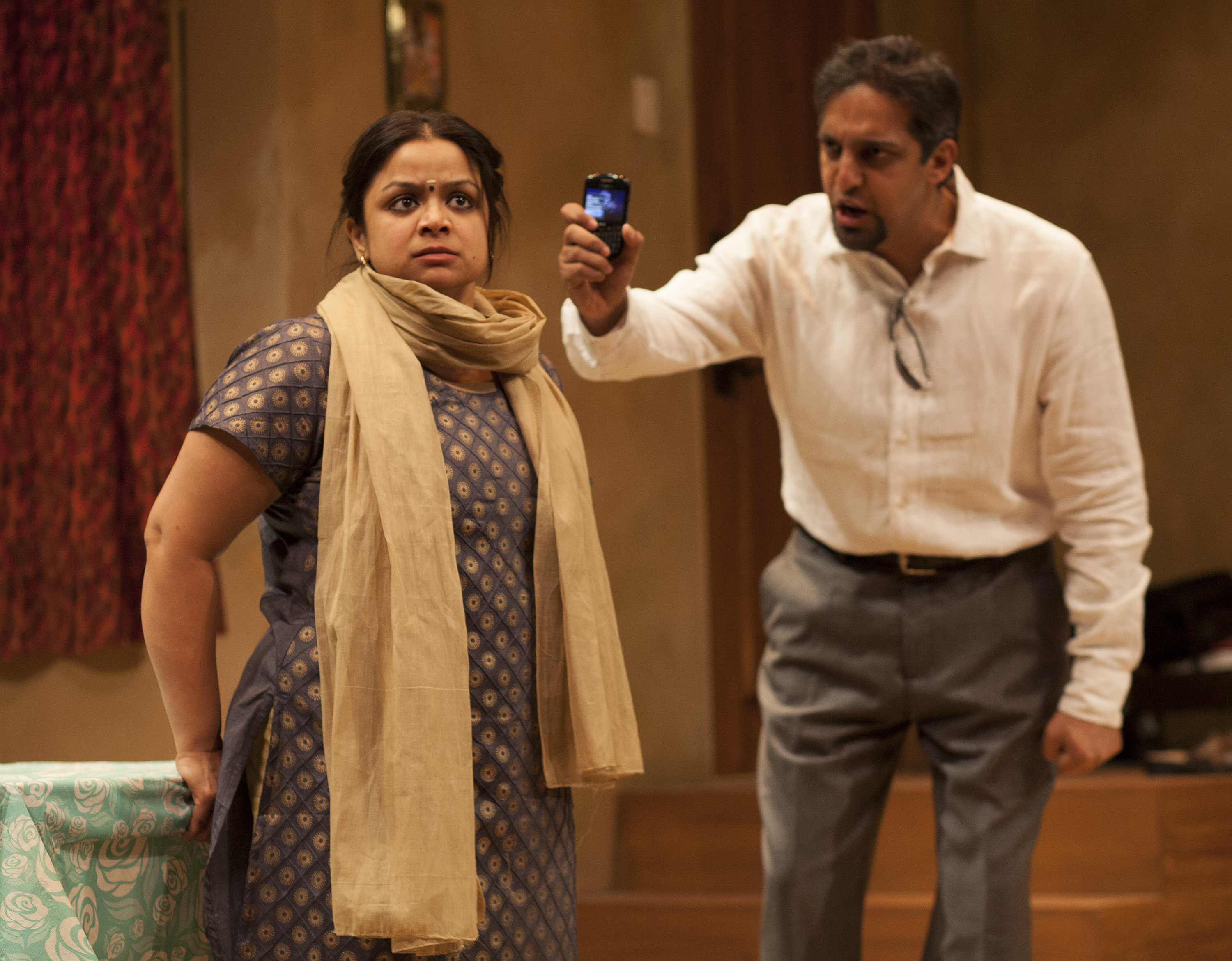
Anusree Roy as Malini and Asha Vijayasingham as Usha in Free Outgoing. The play ran at Factory Theatre recently and exposes the sexual hypocrisy of society.

Anusree Roy as Malini and Asha Vijayasingham as Usha in Free Outgoing. The play ran at Factory Theatre recently and exposes the sexual hypocrisy of society.

The intimacy of a theatrical experience is doubly enhanced when the stage upon which the set is mounted is a mere whisper away from your eye. It’s as if you are a voyeur watching the domestic squabbles of your neighbour.

In Free Outgoing, the set felt familiar and authentic. My childhood memories of growing-up in a conservative South Indian family are replete with rituals and customs. Every South Indian home had this calendar marked with religious festivals, which the priest would give us at the start of the year. So, when I sighted the old familiar calendar stuck on one side of the wall of Factory Theatre’s set, I knew the ambience couldn’t get more South Indian than that.  Anna Treusch, set designer, deserves kudos for pulling that feat.

All the action transpires within the four walls of Malini Haridas’ (Anusree Roy) home. Haridas, a single-mom to two teenagers, Deepa, a 15-year-old prodigal daughter and Sharan (Andrew Lawrie) an aspiring engineer, is a typical middle-class amma (mom), chugging along as a bookkeeper running a home business as well.

At first, Malini’s overly critical nature‑directed at her son seems harsh. It becomes evident early on in the story that it’s her accomplished daughter that holds the strings to her Mom’s heart. Malini’s love for Deepa shines on her face as she shows-off her daughter’s trophies to her somewhat slimy colleague (Ash Knight). The daughter’s fall from the pedestal upon which she was perched is particularly telling.

When shown a video clip of her daughter’s sex tape, Malini’s incredulous face is a mix of helplessness, anger and betrayal. Roy with her kohl-lined eyes, bright bindi (the dot worn on the forehead by Hindu women) and cotton salwar-kameez, drew us into her world and we watched it slowly collapse around her.

Roy, co-artistic director of Theatre Jones Roy and a well-known playwright herself, competently carried the 90-minute storyline on her shoulders with aplomb.

I was impressed by Kelly Thornton, the director’s ability to get under the skin of the issue. My familiarity with the South Indian culture and the understanding of the multimedia service (MMS) Scandal, as it became known in India gave me the perspective needed to enjoy Free Outgoing, but to others, unschooled in the rigid sociocultural climate of Chennai or the era in which the sex-tape surfaced, portions of the play may have been incomprehensible, confusing even.

Let me give another example of this disconnect. The sveltering and humid climate in Chennai means ones thirst is never fully quenched. Compound this with the fact that the city has a perennial water shortage and tap water is unfit for consumption. So, understandably, drinking water is a precious commodity. I doubt any other non-Indian audience member would have connected the recurring role the bottled water has in the play. I felt some of these ideas should have been North Americanized to give clarity to the plot.

I enjoyed the understated, yet brilliant performance of Ellora Patnaik who plays both the school principal and a member of the building’s tenant association. Her mannerisms were spot on. The playwright’s decision to not show us the daughter added a bit of intrigue.

To sum up, the play’s message and execution, stirred something in my heart. I couldn’t but help imagine the plight of the actual 15-year-old girl on whose life the play was based on. Was she able to move on or would one act of innocent curiosity follow her for life?

In conversation with Anusree Roy

Born and raised in India, Roy imbibed theatre. Her grandmother produced socially relevant plays to fundraise for Mahtma Gandhi’s non-violence movement. Roy says through art comes change and as an artist it behooves her to be responsible for work that brings about social change in society. The Toronto artist is the recipient of the K.M.Hunter Award, RBC Emerging Artist Award and The Carol Bolt Award.

TDD: Did Anupama’s script speak to you and help you understand Malini?

AR: Yes. Anupama’s script really spoke to me. I loved how fearless and
flawed Malini is and I was so drawn to her life story.

TDD: Why is Free Outgoing relevant to the times we live?

AR: It’s relevant because of how intensely technology surrounds our life.
The play is set in 2007, when the “birth” to the viral video began. It’s
such a cautionary tale of how things can spin out of control so fast.

TDD: What was the rationale behind the title (I am hoping Anupama shared
some insights)

AR: Anupama said that it meant two things to her: the idea of outgoing
call being free and how “free” and “outgoing” Deepa used to be before her
sex video went viral.

TDD: Share with us your experience interacting with Anupama?

AR: It was great. The cast and creative team had such a good time with her.
She toured Toronto a bit and we bonded over meals.

TDD: How has your social media experience been? Do you enjoy it?

AR: Yes, I am active on Facebook and twitter. It’s been a good experience
because I am very careful about what I put online and how much I choose to
share. Privacy is really important to me, so I am very particular.

The dilemma of protecting our daughters and sons in the digital age

Standard
Anusree Roy as Malini and Andrew Lawrie as Sharan in Anupama Chandrasekhar's Free Outgoing, which played at Toronto's Factory Theatre. Photo by John Lauener.

Anusree Roy as Malini and Andrew Lawrie as Sharan in Anupama Chandrasekhar’s Free Outgoing, which played at Toronto’s Factory Theatre recently. Photo by John Lauener.

On a recent Sunday, as I watched the plot of Anupama Chandrasekhar’s play Free Outgoing unfold in front of my eyes, I couldn’t but help shudder at the “what ifs”.

As a super cautious user of social media, all my actions are governed by the sobering thought that this seemingly innocuous technology has wrecked lives, ruined careers and even helped usher in a revolution or two in some parts of the world.

Free Outgoing is a wake-up call to parents of all teenagers. The 90-minute saga aptly exposed the double standards of a society that has no qualms whatsoever about verbally and psychologically lynching a young girl for her naive curiosity, while the boy, who I felt was equally culpable, went scot-free.

Here’s a bit of a background on the play’s genesis. In 2004, two students from a public school in New Delhi, India, filmed themselves having sex. The video of their act went viral. It wasn’t long before all major newspapers and television networks decided to cash in. The (multimedia messaging system) MMS scandal as it came to be known, fed the baser instincts of an entire nation and kept them riveted. At every opportunity, the so-called moral gatekeepers of Indian society chimed in with their viciousness. They ostracized and condemned the young girl and her family. For weeks, the girl’s family sat trapped in their apartment because an angry mob and a ruthless media stalked them.

A year later, Indian society’s blatant hypocrisy came to the surface yet again, when a well-known Indian actress (Khushboo) penned a newspaper column in which she urged all folks, including unmarried women, to practice safe sex. In Chennai, a city in India, steeped in so-called traditional values, Khushboo’s words caused a moral tsunami.

Free Outgoing3

Anusree Roy and Ash Knight in Anupama Chandrasekhar’s Free Outgoing. The play exposed the sexual hypocrisy of Indian society. Photo by John Lauener.

Chandrasekhar, a business reporter from Chennai channelized her indignation into crafting a compelling play that exposes the sexual hypocrisy of Indian society.

“Free Outgoing was very loosely inspired by the two much reported incidents in India that outraged me,” explains Chandrasekhar, in the playwright’s notes. “It became quite evident that in cases where a girl/women’s sexuality is under social scrutiny, the penalty she and her family have to pay is quite out of proportion to the act committed.”

Kelly Thornton, artistic director, Nightwood Theatre—who directed the play here in Toronto — said she heard of Free Outgoing in 2007 when it premiered in London’s Royal Court Theatre. The theme connected with her on many levels.

“The world of the play sits on the precipice of technological blast off where now Twitter, Instagram, smart phones and sexting are much more than just part of our vernacular,” said Thornton. “We have created a world where lives can be changed overnight. Indeed technology is the great colonizer of our time, changing societies so rapidly that its effects are still relatively unknown. In many ways, it’s still a wild frontier…”

What disturbs me as a media professional and a mother is that success of any social media endeavor these days is gauged on an odd barometer—whether the image or idea went viral or not. The danger of this is, some important messages get diluted or are not heard because they did not feature a cat playing a piano.

Free Outgoing’s relevance, I realized is not limited to India, its central theme will eerily resonate with Canadians as well. Remember, Rehtaeh Parsons, a 17-year-old who took her life after being raped, then bullied on the Internet? What about Amanda Todd? Amanda, 15, committed suicide in her Port Coquitlam home because of the bullying she endured online after a topless picture of her was shared via social media.

I believe Free Outgoing should be shown in schools and other educational institutions as a public service message, because god knows, our children are oblivious to the danger of social media.

In my next blog, I will feature an interview with Anusree Roy, who played the lead role of the mother (Malini Haridas) in Free Outgoing. Stay tuned.

Move over butter chicken, the Kerala chicken curry is here

Standard
Kerala, a coastal state in India, boasts of cuisine that's full of flavours. The Kerala chicken curry is especially a universal favourite

Kerala, a coastal state in India, boasts of cuisine that’s full of flavours. The Kerala chicken curry is especially a universal favourite.

In the earlier posts, I attempted to capture some sights and stories of South Asians in Toronto.

Well, it’s time to direct the rickshaw towards some culinary delights. A highlight Toronto’s multicultural identity is that the city offers its patrons a whole variety of ethnic food to choose from. Some are wildly popular, others remains hidden gems. If I asked you to cough up the names of some Indian dishes, you are more than likely to answer: butter chicken, naan, chicken tikka or palak paneer.

Since the Canadian palate appears to have fallen in love with the mild flavours of the ubiquitous butter chicken and its perfect dance partner, naan, most restaurateurs are wary of introducing anything else on their menu. If it works, why fix it, right?

Here’s the thing; Indian cuisine, much like the country itself is vast and varied. Each region has its own distinct culinary style.  Many of the dishes will tantalize the taste buds and send you to food nirvana.

Yes, it’s great, butter chicken and the samosas have nudged their way right into the mainstream fare, but these are not the prototypes of India’s mind-boggling gastronomy. Allow me to introduce you to some less-known, nevertheless great mouthwatering dishes.

Nestling amidst swaying coconut trees and lush greenery, is Kerala. A coastal region in the Southern region of India characterized by groves of mango, jackfruit and coconut trees, punctuated with rubber, coffee and tea plantations, cashew nut trees and orchards redolent with spices such as cardamom, cinnamon and pepper.

Often referred to as God’s Own Country, Kerala definitely lives up to its moniker. What’s unique about Kerala’s cuisine is that unlike the calorie-laden richness of butter chicken, food hailing from this region is light (as it’s steamed or cooked with minimal oil). The dishes sport rich flavours tempered usually by a paste of coconut, ginger, green jalapeno, black pepper, nutmeg, cardamom and other spices.

Fish, fowl and vegetables are an integral part of Kerala’s cuisine. At the time of festivals, weddings and other occasions, food is served and eaten on a banana leaf.

Here’s a recipe for Kerala chicken. You can substitute the fresh powdered spices with (Eastern brand Chicken masala) readily available in any Kerala store in the GTA.

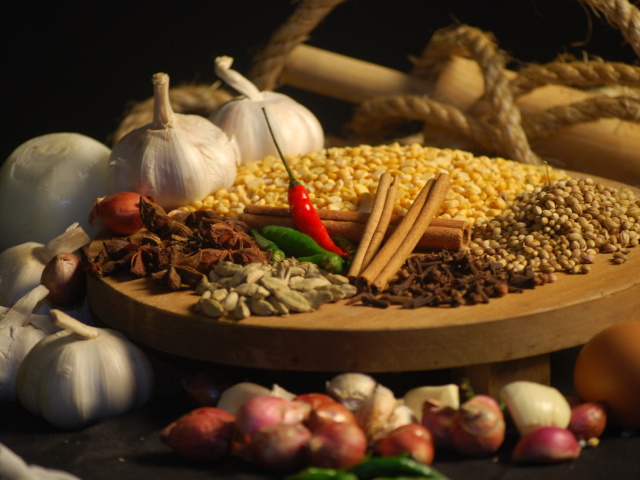
Kerala cuisine is redolent with spices such as cardamom, peppercorn and coconut. Image courtesy Zastavki.com

Kerala cuisine is redolent with spices such as cardamom, peppercorn and coconut.
Image courtesy Zastavki.com

KERALA CHICKEN CURRY

Serves six

You will need:

Chicken – 2 lbs. bite-sized pieces

Onions – 1 large chopped

Tomatoes – two large diced

Ginger/ garlic paste – 1½ teaspoon

Oil (Canola/vegetable) – 3 tablespoon

Coconut (grated) – 1/3 cup

Red chilly powder— 1 teaspoon

Fennell seeds — ½ teaspoon

Cumin seeds — ½ teaspoon

Peppercorn— ½ teaspoon

Cloves — 4 nos.

Cinnamon— 1-inch stick

Cardamom — 3 nos.

Lemon juice — one lime/lemon

Yoghurt— 3 tablespoons

Prep work:

Marinate chicken pieces in lemon juice, yoghurt and salt. Refrigerate for a couple of hours

Dry roast on low flame and powder: Fennel seed, cumin, cloves, peppercorn, cardamom and cinnamon

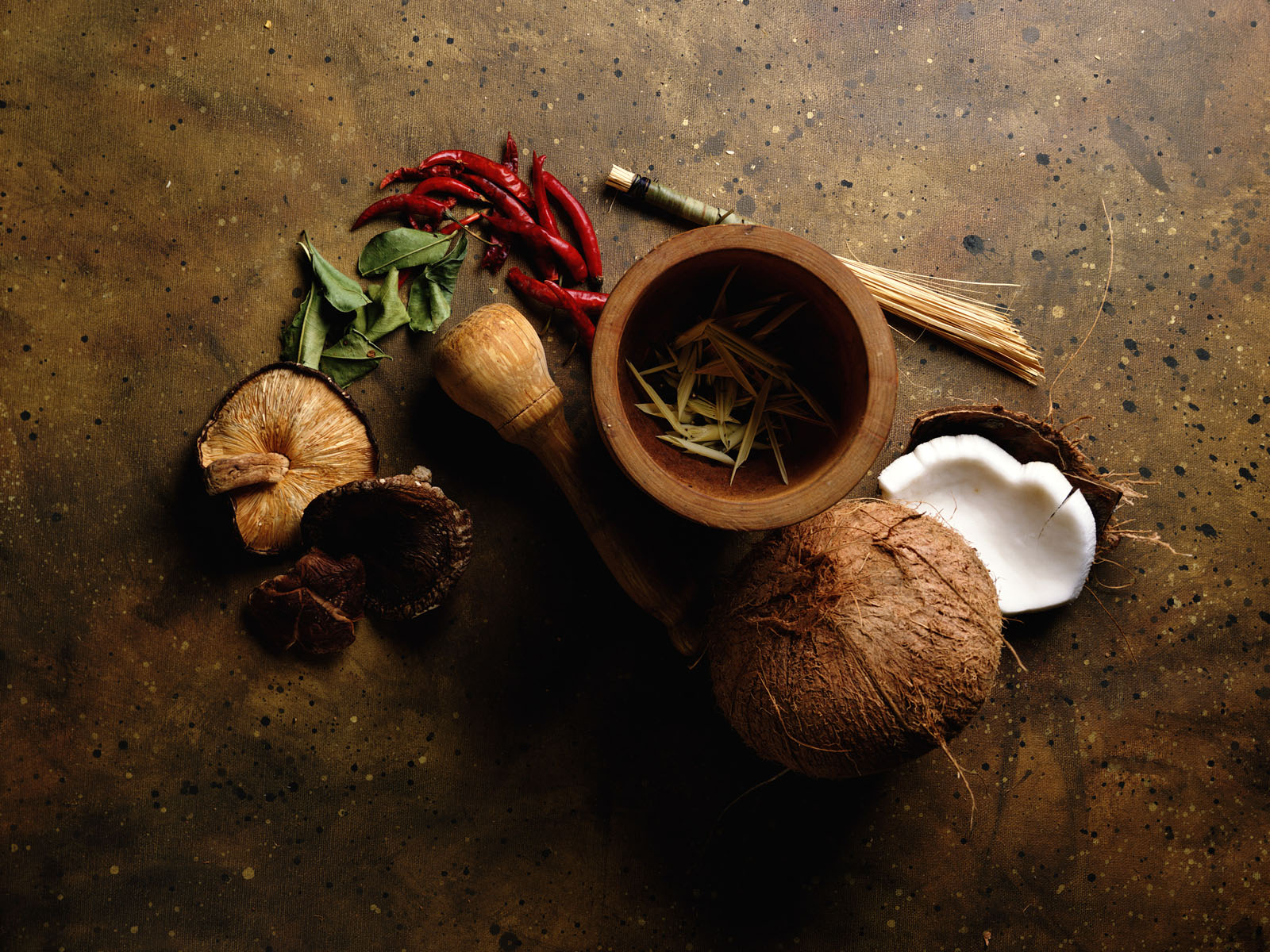
Kerala's cuisine boasts of staples such as coconut and fresh aromatic spices such as peppercorn, cardamom and cinnamon.

Kerala’s cuisine boasts of staples such as coconut and fresh aromatic spices such as peppercorn, cardamom and cinnamon.

Instructions
1. Heat oil in a non-stick or heavy-bottomed pan. Toss and saute the onions.

2. Add ginger, and garlic paste. Cook until onions turn golden brown.

3. Add diced tomatoes till it softens and has a sauce-like consistency. Add salt, red chilly powder and Eastern chicken masala. Turn the heat to minimum.

3. Toss in coconut (grated either fresh or frozen) and about 1 ½ tablespoon of powdered spice mix. Add very little water and make a paste.

4. Add coconut and spice paste to the simmering sauce. Saute for 2 to 3 minutes. Add half-a-cup water.

5. Now add in the chicken pieces. Cover and cook in medium-low heat for 20 minutes. Check to ensure chicken is fully cooked. Sprinkle remaining dry spice mix. Cover and let the flavours sit.

Enjoy it with steamed white rice or tortillas

Don’t dare him, he may take you up on it

Standard
Suresh Joachim, Canada's #1 record holder will be undertaking a World Peace Marathon in 2017. Illustration courtesy Sureshjoachim.com

Suresh Joachim, Canada’s #1 record holder will be undertaking a World Peace Marathon in 2017.
Illustration courtesy Sureshjoachim.com

As a rookie reporter, I groaned whenever I heard/read about Suresh Joachim (pronounced Joe-Kim) attempting a stunt for the Guinness World Records (GWR).

The unstoppable thrill-seeker successfully pulled off every imaginable dare. As a result, I ended up writing at least one story every other week on the Mississauga man. For a while, my colleagues joked I had made it as a beat reporter after being on the job for less than six months.

That was some years ago.

Now at 43, Joachim has shattered 68 world records in the last 15 years. Alas, he does not hold the world record for most records. That honour belongs to Queens, N.Y. native Ashrita Furman, 56.

Joachim, an accountant by profession, however remains unperturbed because as he points out, Furman has been at it for 40 years, whereas he himself has  only started.

So far, the Sri Lankan-Canadian, holds records for among other things: the most distance moon walked in 24 hours (49.252 km), ironing continuously (55 hours, five minutes), most time spent watching television (69 hours and 48 minutes), longest dance marathon, longest drumming marathon and his very first record —running 3,495 kms every hour for 42 days.

Some of his records are quirky, others require endurance and training, but in the end, he manages to accomplish both with characteristic modesty and same single-mindedness.

Suresh Joachim is Canada's #1 record holder. He has broken 68 world records.

Suresh Joachim is Canada’s #1 record holder. He has broken 68 world records.

“I have experienced a lot of pain in my life and that’s what drives me,” said Canada’s # 1 record holder. “I get the power and strength to do the things I do because of my faith in God. I feel this is my purpose and this is what I was born to do. I am only taking the steps he (God) wants me to take.”

Celestial intervention or not, there’s one record he vows he will never repeat again.

“I balanced on one foot 76 hours and 40 minutes,” he said. “It was very painful. If someone offered me $10 million to do it, I still won’t do it.”

Growing up in Jaffna, Sri Lanka, during a tumultuous time in the country’s history, the father of two, watched and experienced the ethnic strife between the Tamils and the Sinhalese communities escalate to the point when violence was part of people’s daily lives. Peace was something elusive and precious.

The staid bookkeeper said he decided to become a serial thrill-seeker on his 21st birthday after an uncle gifted him the shiny silver Guinness World Records book.  Joachim recalls experiencing a sense of awe when he cradled the mammoth book. Excited and wide-eyed, he devoured the contents greedily. It was as if the book was a gateway to a world of possibilities.  And thus began his sojourn.

Joachim plans to embark on his most ambitious project yet. Slated to begin on Christmas Day in Bethlehem in 2017, the World Peace Marathon will wrap-up in Toronto a year or two later. As part of the project, Joachim will carry the peace torch and run across 76 countries and 120 cities to raise $1 billion.  Along the way, he will also get some 500 million people to sign a petition for one day to be declared World Cease Fire Day, he says.

Like me, I bet you are wondering where does he find the money to do all this? The answer is simple. Joachim finances his all endeavours through sponsorships.

Which record did he have most fun? He says all were equally thrilling, but his record for the fastest feature-length film ever made (11 days, 23 hours and 45 minutes) remains close to his heart. The movie Sivappu Mazhai (Red Rain) was shot in India in 2009.


Pink Ladoos: empowering the community through dance

Standard
Nach Balliye, a dance group, started a grassroots movement here in the Greater Toronto Area (GTA) to celebrate the girl-child. Photo courtesy Nach Balliye

Nach Balliye, a dance group, started a grassroots movement here in the Greater Toronto Area (GTA) to celebrate the girl-child.
Photo courtesy Nach Balliye

The recipe to create pink ladoos is quite simple. It’s passion mixed with equal parts dance and activism, served with a dollop of empowerment.

Pink ladoos are not just about adding a rose-coloured hue to a dessert; it’s an extraordinary idea that celebrates the girl child and her arrival into a world that’s bent on rejecting her. It’s about letting the entire community know the precious bundle of joy swaddled in blanket needs human warmth and love as much as the boy child.

Licensed commercial pilot Sumeet Gill, 29, started Pink Ladoos, a grassroots movement in Canada this past year after a chance meeting with Dr Harshinder Kaur, a world-renowned activist from India few years ago. Despite death threats on her life by disgruntled critics, Dr. Kaur continues to carry on a passionate crusade against female feticide.

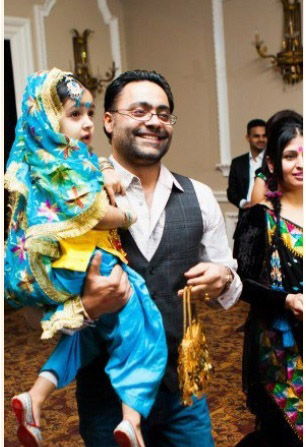
A father brings his daughter to the Lohri for Her, an event in Toronto by Nach Balliye, that celebrates girls. Photo courtesy Nach Balliye

A father brings his daughter to the Lohri for Her, an event in Toronto by Nach Balliye, that celebrates girls.
Photo courtesy Nach Balliye

So impressed was Gill by the pediatrician from Patiala, India, she took time off from her work and followed her to Punjab. As Gill and the doctor travelled to remote villages talking to women, it became apparent the prejudice against girls was deep-rooted and stubbornly entrenched in the psyche of people. Horror turned to disbelief when Harshinder Kaur told Gill the gender ratio of boys to girls in Brampton, Ont. was even more distorted (higher) than that in Punjab.

“I was shocked when Dr. Harshinder Kaur told me the issue of female feticide was common here in Canada as well,” Gill said. “Her strategy was to reach out to youth in the GTA and appeal to them to reject old customs. I was very inspired by her. So, I arranged for her to come back and talk at a seminar I organized. At the seminar, the doctor spoke to us about the consequences of female feticide on the human race, not just one community. It was quite an eye opener.”

The talk lit a fire in the youth. Gill who was part of Nach Balliye, a dance group she and her friends formed to promote culture at that time, decided to use the power of dance to educate families. They turned Nach Balliye into a springboard of activism. Then, this past year, Gill and her friends started another grassroots movement in Canada—Pink Ladoos. The purpose of Pink Ladoos is to start a dialogue with Punjabi families shackled by outdated social norms.

How does it work? New parents, blessed with a girl register at Nach Balliye’s website. The Pink Ladoo team, dressed to the nines in traditional dresses, visits the home of the parents with a box of pink ladoos. Once there, they inject the home with with their dance and music. Then they connect with every member of the child’s family and talk to them about nurturing the girl.

“As a group we decided to come up with mechanisms to celebrate and focus on the positive,” said Gill. “We wanted to be part of the solution. I believe if we bang on doors long enough, they will open.”

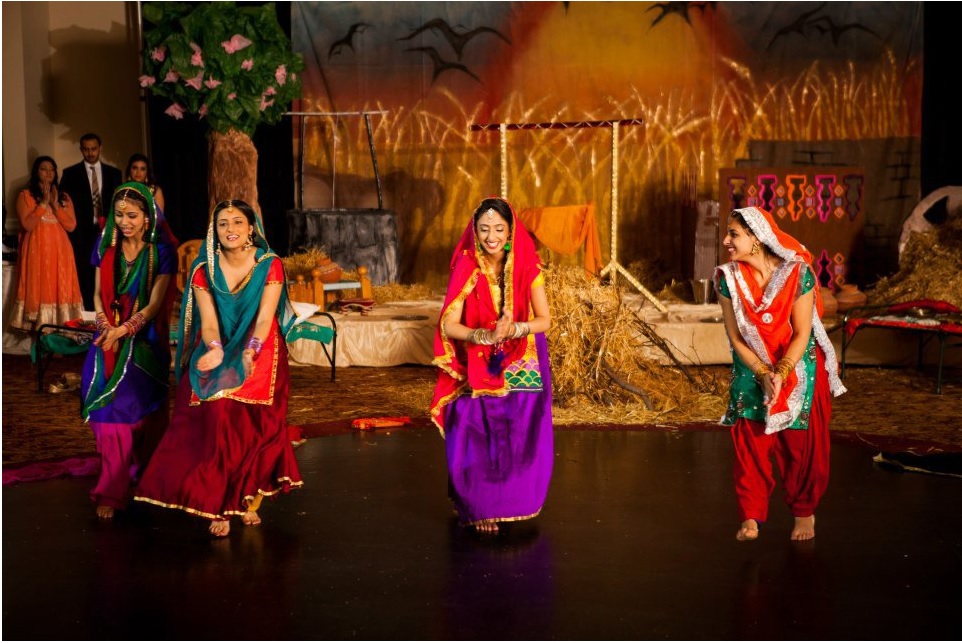
Lohri is a harvest festival celebrated by the Punjabis. Lohri for Her, a grassroots movement recreates a scenic village in Punjab to host its annual event. Photo courtesy Nach Balliye

Lohri is a harvest festival celebrated by the Punjabis. Lohri for Her, a grassroots movement recreates a scenic village in Punjab to host its annual event.
Photo courtesy Nach Balliye

Dr. Harshinder Kaur serves as a GPS for the Canadians. While she continues to work—at the macro level — with various governments and international agencies such as United Nations (UN) orchestrating policy changes to curb female feticide, Nach Balliye is attempting to change the mindset of people at the micro level through Pink Ladoos and Lohri for Her, an annual event where the girl child is celebrated during the harvest festival of Lohri.

“We are not an event, we are a movement,” says Neeli Grewal, one of the members of Nach Balliye. “Pink Ladoos is a validation for the family to celebrate the girl-child. Our vision is to raise awareness of the issue of gender-selection by going door to door. Our movement is already creating a ripple effect. In just few years, we hope to make Lohri for Her a Canada-wide initiative with events taking place simultaneously across different cities in Canada.”

For more information visit http://www.lohriforher.com.

Canada’s shameful secret – female feticide

Standard
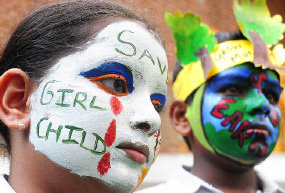
A girl gets her painted in Chandigarh, India to create awareness of the disturbing practice of female feticide. (Reuters)

A girl gets her painted in Chandigarh, India to create awareness of the disturbing practice of female feticide. (Reuters)

Ladoos are a popular Indian dessert made up of chickpea flour, sugar and few other ingredients. Gifting a box of ladoos to someone means you are in essence sharing with them an occasion that warrants a celebration—engagement, wedding, new job and what not.

It’s customary to distribute these warm golden coloured sugary balls to neighbours and friends at the arrival of a male child, but when the wail of a newborn turns out to be that of a girl, in some homes, the news is greeted with a pall of gloom. The sub-text here is clear — a girl-child does not merit the ladoo. Her arrival is unwelcome. The girl child is considered a burden on her parents.

While the purpose of this blog is to present the cultural snapshot of South Asians in Toronto, it would be remiss of me, if I glossed over or entirely ignored the unsavory truths. These stories need to be told even though the reality may be unpalatable to some. Let’s talk about this elephant in the room —Female feticide.

The custom of aborting female fetuses is especially prevalent among some South Asians and Asians here in the Greater Toronto Area and in Vancouver. In India and China the issue is largely driven by prejudice, outdated practices and poverty. So, it’s inexcusable that, it’s allowed to happen on Canadian soil. I blame inadequate policies, affordability and the ease with which parents can opt for sex determination and abortion as the reasons why we are having this unpleasant conversation.

Let me begin by first observing female feticide is not exclusive to the South Asians, it’s disturbingly common in other countries like India, Korea and China where a male offspring is preferred. Along with all the other imports of tradition, this ugly custom, has somehow found its way here in the Greater Toronto Area (GTA) and that’s the sad part.

Two years ago, Toronto’s St. Michael’s hospital undertook a study: Sex ratios among Canadian live born infants of mothers from different countries and analyzed 766,688 births that took place in Ontario between 2002 and 2007 and found mothers, transplanted from South Korea and India were ‘significantly’ more likely to have boys for their second child. The report raised concerns that sex-selective abortion was happening right here under our noses.

Ladoo is a popular South Asian treat that's given when a family welcomes a male child.

Ladoo is a popular South Asian treat that’s given when a family welcomes a male child.

“Our findings raise the possibility that couples originating from India may be more likely than Canadian-born couples to use prenatal sex determination and terminate a second or subsequent pregnancy if the fetus is female,” reads the study, published in the Canadian Medical Association Journal.

This has skewed the gender balance. According to StatsCan’s 2006 census figures, there are 932 girls to 1,000 boys under age 15 in the South Asian community. Compare this to the ratio for Canadian-born mothers: 105 boys for every 100 girls. The numbers in the South Asian community in the Toronto area become much more pronounced: According to the Toronto Star, the stats show 904 girls to 1,000 boys in Mississauga, Ont. and 864 girls to 1,000 boys in Brampton, Ont.

Even though these numbers are telling, the silver lining on this dark cloud, is that sex-selective abortion is not — thankfully — a common practice here in Canada. Only a small percentage of people practice this vile custom. Even that will slowly change because changing demographics of the population in the GTA means the young and educated parents born and raised in Canada are rejecting gender biases. Many young women are raising awareness.

In my next blog, I will feature the heart-warming story of how a group of young women issued a clarion call to the community to reject old-fashioned customs and the rising groundswell of support for their cause.