Puja Amin: The passion, the promise and the pursuit of excellence

Standard
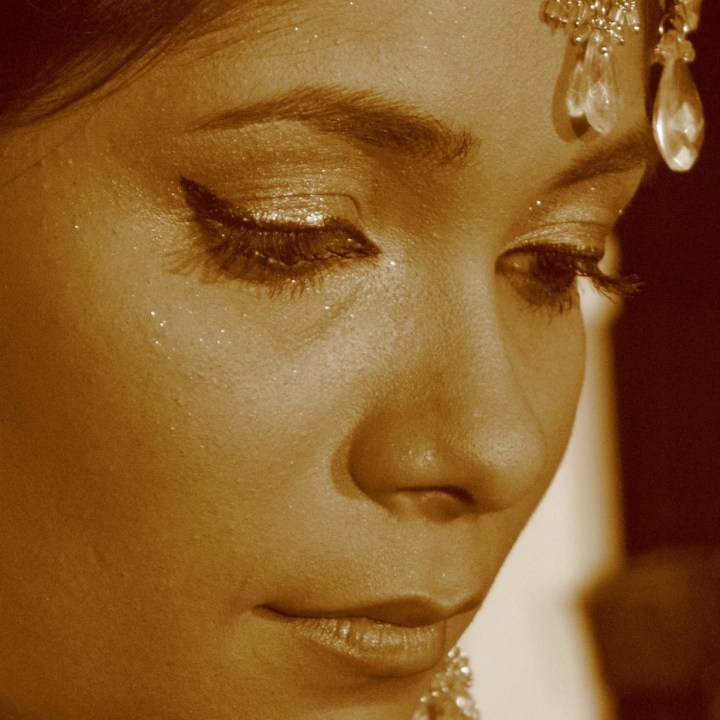
Puja Amin, artistic director/founder of Sanskriti Arts Ensemble (SAE).

Puja Amin, artistic director/founder of Sanskriti Arts Ensemble (SAE).


Well, you can always spot the impassioned souls with a look into their eyes.

Puja Amin’s are sparkling and alive when she talks all things dance.

I think it may also have to do with the fact that as a Yogi, Puja’s mind and body are in sync with her spirit and that inner calm radiates outwards as well.

Coincidentally, as a child, Puja’s dad bribed his daughters to sit through the yoga sessions at home. The girls were understandably restless and did not care much for promise of enlightenment, but they stuck around.

Today, Puja, 37, can’t thank her dad enough because having an intimate knowledge of Ashtanga Yoga, classical dance and human physiology (she has a degree in physiotherapy), has allowed her to help students and clients find relief from pain, depression and other ailments relating to the mind, muscle and joint.

Dancer, choreographer, yoga teacher and volunteer, Puja’s hat rack is crammed. Her life, much like the dance she choreographs has had ebbs and flows, but right now, there’s just serenity.

“I have never looked back,” Puja says about her life’s journey. “I never regretted anything that has come my way. Every single thing in my life–whether right or wrong– has made me who I am today. I live in the moment. I don’t tend to look too far into the future.”

The student who loved to dance
Puja2

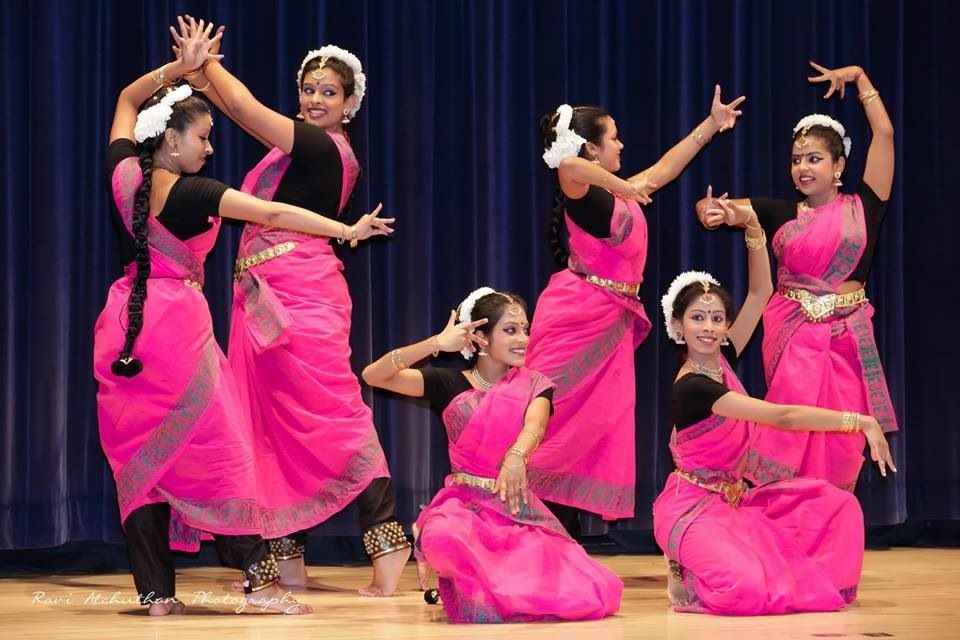
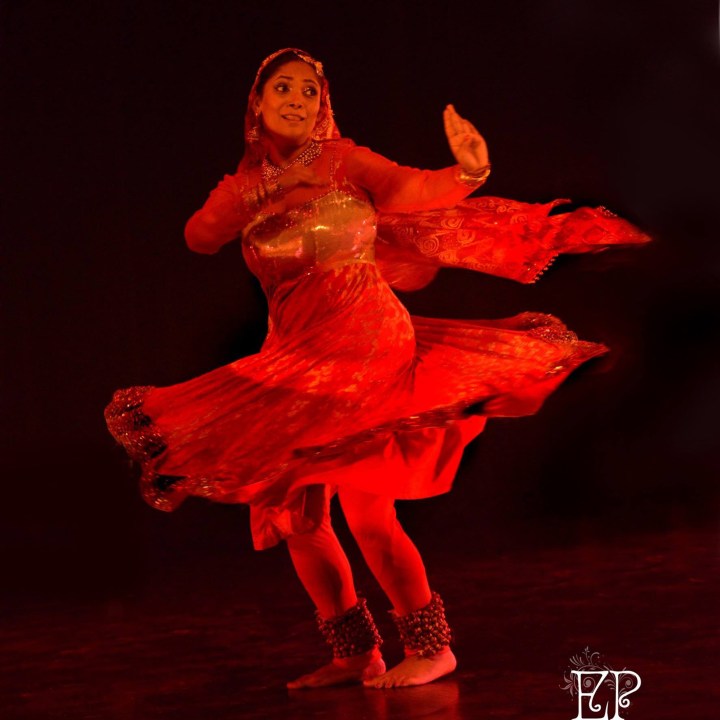
Puja Amin, artistic director/founder of Sanskriti Arts Ensemble (SAE) is a well-known Kathak dancer.

Puja, the artistic director/founder of Sanskriti Arts Ensemble (SAE), a dance and yoga academy with over seven branches across the GTA, has a coveted spot in the competitive “dance school” market in the GTA.

If her dad inspired her to pursue yoga, she credits her mom Daksha Shah with instilling in her the love for arts–both visual and performing.

As a young girl, Puja balanced the rigours of dance training and academics well. She excelled in both. Years ago when a six-hour dance session and a crucial exam fell within days of each other, Puja sought her mom’s permission to skip the rehearsals.

Daksha looked her daughter in the eye and said, “you knew about the dance and exam in advance and committed to both. So, now, you have to handle them both. No excuses.”

That’s why Puja’s students know better than to beg off from classes because of schoolwork. It won’t fly. She expects nothing but 100 per cent from them and in return she gives them all.

“By God’s grace, the path has come to me,” she said of her life as a dancer/yoga teacher. “I have never gone chasing anything. Life has led me to what I have become today and I accepted what it offered…”

Having worked with Bollywood heavyweights like Sanjay Leela Bhansali, a creative maverick with a Midas touch, Puja understands the demands of the profession.

“Working with creative minds is not easy,” she said. “When I worked with Sanjay Leela Bhansali, we would work for hours on a project and he would scrap the entire thing in a second to come up with something entirely different. He’s a creative genius.”

An uncompromising attitude towards work and a thirst for learning are not just traits, they are her signature. Puja who’s currently pursuing her master’s in Kathak hopes to attain an Alankar (PhD) sometime.

Through dance, she equips her students with empowerment, confidence and life skills.

“I tell my students they have to be something (pharmacist/doctor/accountant) and a dancer because you need a backup,” she said. “Degrees give you lot of insight, experience and knowledge and that never goes waste.”

The SAE (Sanskriti Arts Ensemble) has performed in concerts and music videos for Falguni Pathak, Boman Irani, Lisa Ray, Jonita Gandhi, Sukhwinder Singh, Lata Mangeshkar, Priyanka Chopra and Shahid Kapoor amongst others.

Puja Amin, artistic director/founder of Sanskriti Arts Ensemble (SAE).

Puja Amin, artistic director/founder of Sanskriti Arts Ensemble (SAE). Photo by Dinesh Shettigar of life in lens photography.


Dance Diaries

They say, your travels define you. At 16, a young Puja embarked on a 90-day trip to U.S. U.K. and Europe, alone. It was both frightening and exhilarating. The trip would prove to be significant in other ways too. When she returned, she made up her mind to pursue physiotherapy. All through her undergrad and work life, dance chugged along on a parallel track.

When Puja Shah became Puja Amin through marriage and moved to Canada, she worked in the field of Kinesiology for a year, but decided to pursue something that was fulfilling – teaching dance. She set up her school in 2003.

In a new venture, SAE has collaborated with Imagebuilderz to launch Dance Diaries, a workshop with Bollywood choreographer Saroj Khan.

Starting March 25, Saroj Khan will be leading a couple of half-a-day workshops in Mississauga and Ottawa including a special one-on-one sessions with SAE students. The Toronto workshop will take place at the Sanskriti Arts Dance and Fitness Studios, 2249 Dunwin Dr. in Mississauga. The four-day sessions will end with a show on Monday, March 28 at the Maja Prentice Theatre in Mississauga.

“The main motivation behind this (workshop) is to provide a cross-cultural dance platform for kids and adults in Canada and learn from the best of the best in the industry,” said Renu Mehta, president of Imagebuilderz. “And who better than Saroj Khan whose name is synonymous with choreography and Bollywood, to provide that training.”

Puja’s excitement about the upcoming Dance Diaries is palpable. Saroj Khan’s contribution to choreography will go down the history of Indian cinema as path breaking, she says adding the inimitable Khan contributed to the success of actors like Madhuri Dixit, Sridevi, Kareena Kapoor and others.

“I want my students to have the real experience,” she explained on why she was bringing Saroj Khan to Toronto. “Most people just dream of Bollywood. I want the students to know the process, the madness and the hard work that goes on behind the silver screen. And that’s where SAE is different. I don’t want us to do the technical stuff. I want them to dance to express.”.

Interested in taking part in the workshops? Visit here.

Happy, New Year, Pongal, Makar Sankranti and more

Standard

10-pongal-greetings

Saturday, Jan. 9

Event: Matin Osmani and Sameera Nasiry Live
Details: Muzik 4U is bringing a pair of Afghani singers for a concert taking place at Brighton Convention Centre, 2155 McNicoll Ave.

Friday, Jan. 15

Event: Thai Pongal
Details: Tamil Youth Organization will celebrate the festival of Pongal at the Kanthaswamy Kovil, 1385 Birchmount Rd. Scarborough at 6 p.m.

Sunday, Jan. 17

Event: Kismet Wedding Show
Details: Must be Kismet, a wedding show, is taking place at The International Centre, 6900 Airport Rd. Mississauga at 11 a.m. to 6 p.m. Find out about fashion, planning, venue, cakes and confectioneries under one roof.
Contact: For tickets and information, visit here

Event: Panorama India Idol
Details: The 7th annual Panorama India Idol is taking place, Jan. 17 at Don Bosco Catholic School, 2 St. Andrews Blvd. Etobicoke from 10 a.m. to 6 p.m. Finale will take place on Republic Day, Saturday, Jan. 30. At Pearson Convention Centre, 2638 Steeles Ave. E.
Contact: Here

Saturday, Jan. 23

Event: Vaalaiyadi Vaalai
Details: Neerveley Welfare Association Canada will present Vallaiyadi Vaalai an annual dinner and cultural evening for Tamilians at JC’s Banquet Hall, 1686 Ellesmere Rd. at 5 p.m.
Contact: 416-618-7435


Rupi Kaur’s book of poems, Milk and Honey, is insightful, provocative and real

Standard
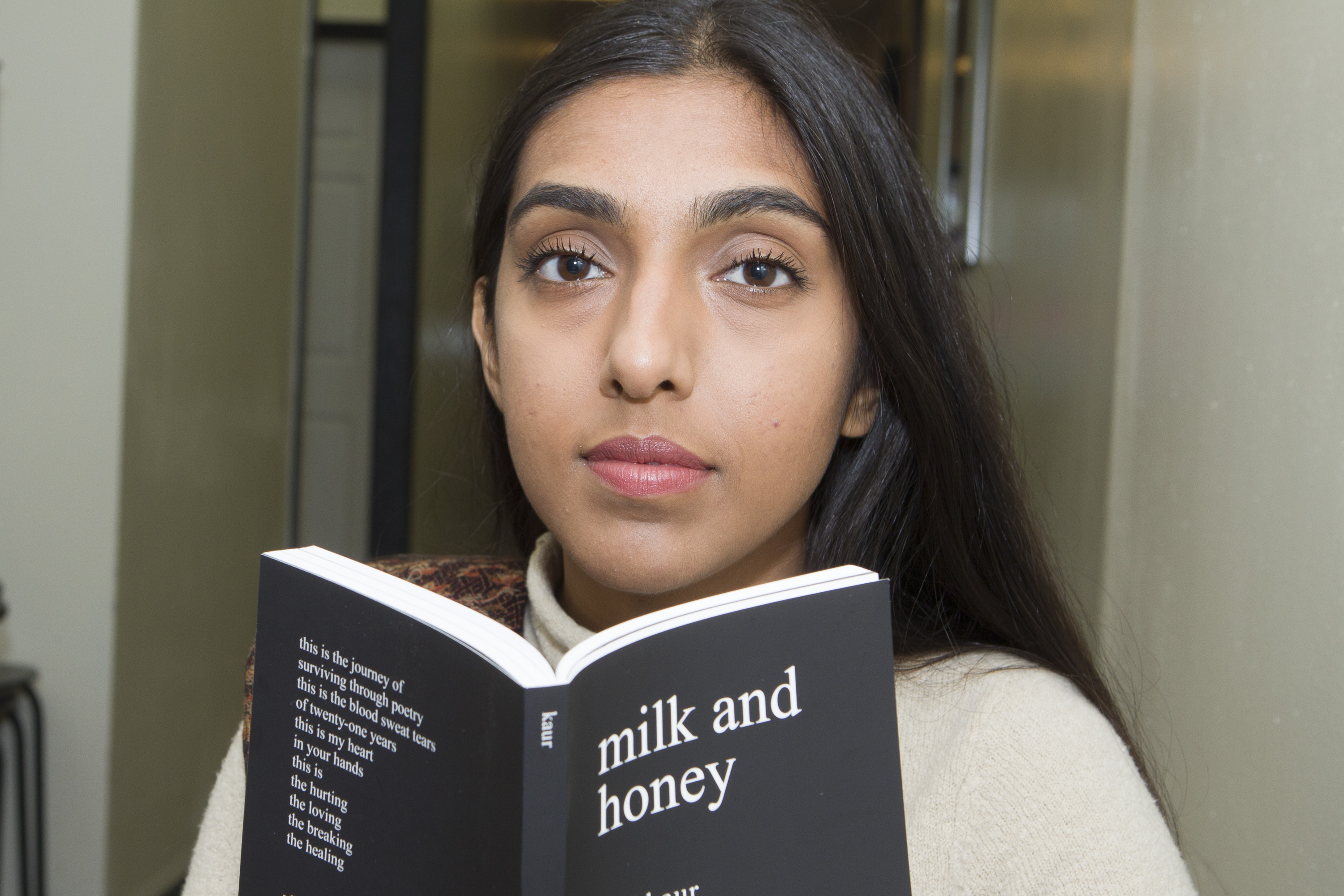
Rupi Kaur, author of Milk and Honey

Rupi Kaur, author of Milk and Honey

If you’re a writer/poet/artist of the audacious kind, a thick hide is an absolute must, right?

Some years ago, a column of mine on online trolls, especially the racist, homophobic and anonymous variety, didn’t sit too well with the very folks. Since the lowlifes couldn’t handle the truth, they ambushed me online and spewed vitriol. It wasn’t pleasant.

So, I get why Rupi Kaur went numb in the aftermath of reactions she received for an art project of hers. The post went viral and while many applauded her, some that couldn’t handle her voice, tried to silence it with death threats.

Rupi wears her grace, intelligence and her I-don’t-give-a-damn attitude well. Simmering with just the right amount of indignation, the author/poet/artist has developed spine made of stainless steel.

Before we get down to Rupi’s awesome book of poems, Milk and Honey (Andrews McMeel Publishing), we have to talk about how some months ago this Bramptonian unwittingly stirred a hornet’s nest on Tumblr, Instagram and Facebook.

A series of photographs on menstruation was what caused the Internet to go into a tizzy. One of the images showed a woman lying on a bed in period-stained clothes and bed sheets. The photographs were part of a school project that challenged students to study the impact of images/art and their interpretation in different social media platforms. By wading into a taboo subject (period) Rupi bore the wrath of ignorant trolls who couldn’t stomach the discomfort. She still doesn’t get why this normal biological process has to be kept under wraps and discussed in hush-hush tones.

Instagram pulled her photographs–twice– saying she violated its guidelines. Undaunted, Rupi took the social media giant to task. In a scathing letter she wrote:

“I will not apologize for not feeding the ego and pride of misogynist society that will have my body in an underwear but not be okay with a small leak,” she wrote in her Facebook post. “When your pages are filled with countless photos/accounts where women (so many who are underage) are objectified, pornified and treated less than human. Their patriarchy is leaking. Their misogyny is leaking…”

Bravo!

Rupi –not unlike so many others featured in the Toronto Desi Diaries– is courageous enough to call out the bigots, the misogynists and hypocrites, but she doesn’t deliver her actions armed with a metaphorical bullhorn. As an artist she has a quiver of potent tools: written/spoken word, drawing and illustrations, poems and photographs.

Her book of poems, Milk and Honey is one such sharp-edged arrow in the quiver.

“My intent was not to disrupt the space,” Rupi told her mom at the time of the uproar over the photographs. “If I am going to disrupt, then it’s going to be for something progressive and positive. I know these moments are crazy, but when you look back at it 20 years from now, talking about periods will be normal and my kids and their kids will wonder why I got all this attention?”

Milk and Honey is divided into four chapters and deals with sexual abuse, love, loss and healing. Rupi’s words question everything: Body hair, periods, sex, love and lovemaking. Her observations are astute.Rupi words

“Milk and honey are medicinal in our culture,” Rupi explains. “I made a reference to them in a spoken word event and loved the analogy. To me, they represented resilience and strength.”

The event she’s referring to happened in 2013 and afterwards Rupi remembers creating a Word document titled Milk and honey without a clue on what the page would hold. Slowly, but surely, the poems emerged, one by one.

“As woman of colour, I think it’s such a battle to be a woman,” Rupi said. “Sometimes I sit back and think about it. The fact that women in Indian survive birth to me means we are already lottery winners.”

Perhaps, I don’t deserve nice things/ cause I am paying for sins I don’t remember or this one (my favourite) or how about this one? Our backs tell a stories/no books have the spine to carry ~ women of colour

RupiKaur_crBaljit

Toronto author/artist/poet Rupi Kaur has recently released her book of poems, Milk and Honey. Photography by Baljit.

The book is pure poetry and forces the psyche to delve into the fathoms of the words.

“Sexuality is very important in the Indian context,” she said. “Take rape for instance, we are one of the communities that have the hardest time accepting rape because we are told over and over again that topic is only to be discussed behind closed doors.”

Just as they began flowing, one day the torrent of words stopped. And just like that, Rupi knew this journey of verses had concluded.

When Rupi’s art received backlash, coincidentally, she gained a whole flock of supporters as well. Her cheerleaders continue to walk and support her.

Milk and Honey is available in all leading bookstores and can be purchased online as well at www.andrewsmcmeel.com or www.rupikaur.com.

Professor Surinder Singh’s music brings forgotten notes to life

Standard
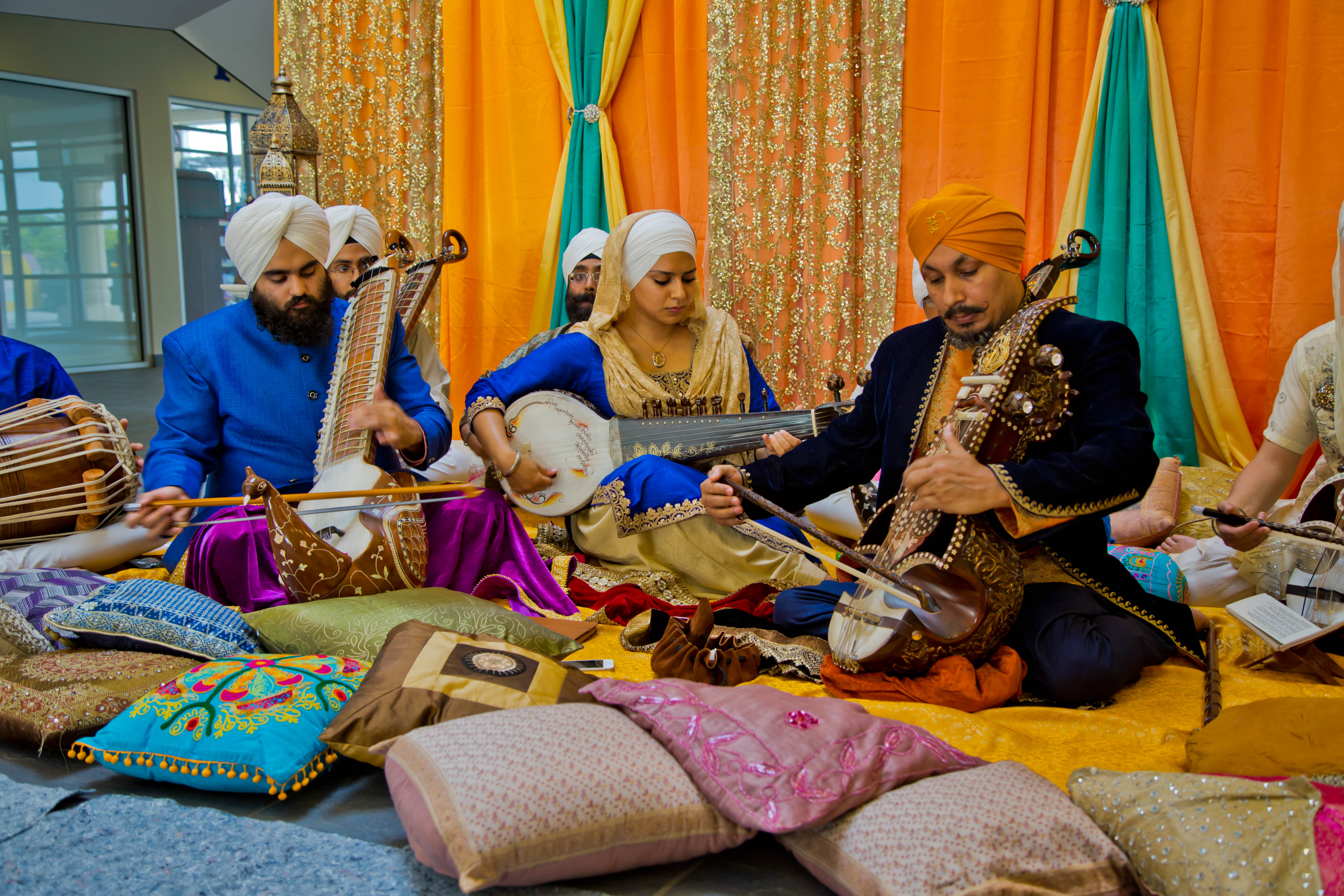
Prof. Surinder Singh (in the centre) delights the audience with sounds from forgotten musical instruments that defined Sikh spirituality. Photo courtesy of Harbiz Inc.

Prof. Surinder Singh (in the centre) delights the audience with sounds from forgotten musical instruments that defined Sikh spirituality.
Photo courtesy of Harbirz Inc.

The singing Sikh

When a regal looking Sikh in an azure blue Sherwani began to play few bars of music on the Saranda, it was powerful and emotional experience.

The Saranda, an ancient Indian instrument, dating some 500 years or more, had all but disappeared from our society. The string and skin instruments such as rabab, Jori (a tabla-type drum), taus, and dilruba were an integral part of the Kirtans sessions delivered by Sikh spiritual leaders like Guru Arjun, Guru Gobind Singh and others. Their pure notes travelled across the room in perfect resonance. Remember, it was an era devoid of mics, expensive sound systems and amplifiers.

Music and prayer went hand-in-hand and an enlightened soul was the byproduct of this union.

Slowly, over the years, the ubiquitous harmonium, nudged these vessels of sublime sounds out. A few of instruments from the bygone era found their way into British museums where they languished in anonymity until a musician on a quest to decipher the meaning of the Sikh Shabds (scriptures) stumbled upon them.

Surinder Singh, popularly known as Prof. Surinder Singh, founder, director of Raj Academy, a United Kingdom (U.K.)-based organization, with branches here in Toronto, has devoted his life to the revival of the Sikh musical heritage. His students learn Gurmat Sangeet and Naad (sound) yoga.

The spirit of music

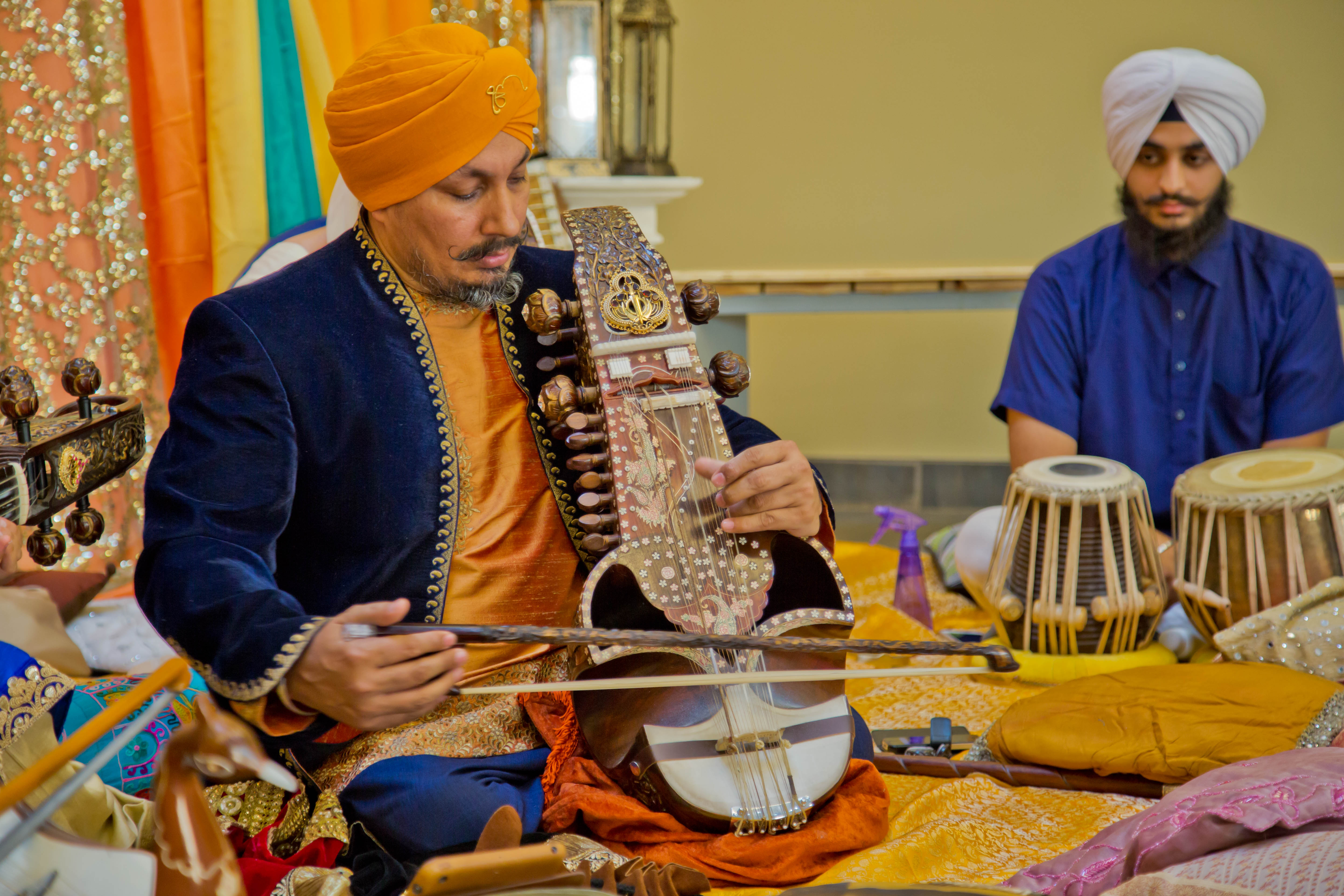
Prof. Surinder Singh seen here playing the saranda. The ancient musical instrument which had faded into obscurity has been revived by Surinder Singh. Photo courtesy, Harbirz Inc.

Prof. Surinder Singh seen here playing the saranda. The ancient musical instrument which had faded into obscurity has been revived by Surinder Singh.
Photo courtesy, Harbirz Inc.

When Surinder saw the beautiful instruments tucked away in museums, he thought it was sacrilege that “his music was in prison.” So, he liberated them.

At 13, while learning Indian classical music, a young Surinder questioned his gurus – Pandits Kharaiti Lal Tahim and Mahant Ajit Singh, on the underlying meanings of the raagas and scriptures and how they mattered.

His wise teachers told him to embrace meditation or else, they said he would have to make room for medication. Those words didn’t hit home, until an accident at 19 incapacitated him physically and psychologically. It was then he understood music’s power to heal the body.

“My spiritual yearning and my curiosity led me to ask my gurus the meaning behind the Shabds or a particular raga and how they were relevant to me daily life,” Singh said. “As I looked deeper and deeper into ancient India’s science of sound, I followed the path and the footprints led me to England.”

Surinder Singh searched and found two individuals in India that could carve wood to perfection and install natural gut strings into rababs and sarandas. much like the way other craftsmen did more than 500 years ago.

When coaxed, the instruments, under a skilled musician’s fingers or the tanti saaj as the people that master the Gurumat Sangeet are known, produce sounds that soothe the restless mind create a spiritual awakening.

“In the Western world (England, Russia, U.S. Canada and others) there are 3,000 musicians today that are playing the music and applying the science behind them,” he explained. “So many of them have experienced the healing power of the music and found relief from diseases. This is what pulled me in. I am honestly telling you, I am the happiest and healthiest person walking…there’s no question. This is what music gave me.”

Sublime, surreal and sacred

Singh says listening to the tanti saaj deliver the ragas can transport a soul into a state of bliss. I can attest to that. I heard few bars and felt the tension seep away as the music percolated my psyche.

“The instrument is known as the shadow of your voice,” Surinder Singh said. “There’s this guy, Raj who makes these old Sikh instruments and his father was a third-generation artist who taught him to study the wood and the temperament of music, the string and how to measure those…when I approached this guy, he agreed to make the instruments and the ones he made are identical to the ones I saw in the museum.”

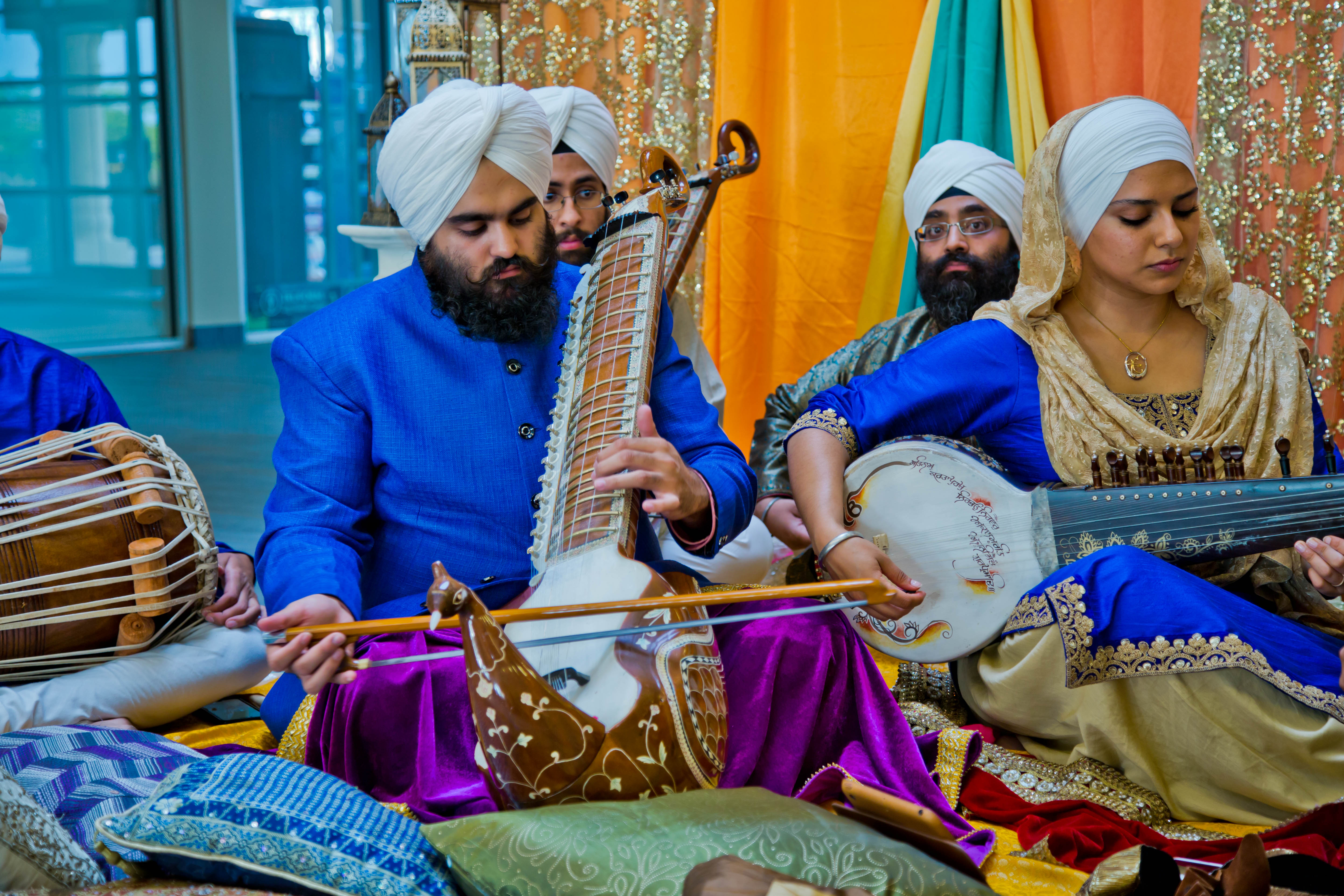
Students of Raj Academy showcase ancient musical instruments that defined Sikh spirituality. Photo by Harbriz Inc.

Students of Raj Academy showcase ancient musical instruments that defined Sikh spirituality.
Photo by Harbriz Inc.

The student and her story

Jasvir Kaur, a student of the Raj Academy and a rabab player, said music became her salvation when the death of her brother pushed her into an abyss of misery.

The Sikh rabab or Firandia rabab is a lute-like instrument and is a precursor to the Sarangi. It has a deep, soulful tempo. It was the choice instrument of Guru Nanak or the “singing guru” as Jasvir calls him.

“One can connect with the philosophy of Guru Nanak through music,” Jasvir, 32, told Toronto Desi Diaries. “His message was universal and beyond the constraints of religion. It didn’t have boundaries. I wanted to connect with the energy, so I started to learn music from “professor ji” (Surinder Singh). When I started, I learned dilruba, another string instrument that’s played with a bow after four years of training with that, I moved to the rabab.”

“For me, this is who I am. My music is not separate from me,” she continued. “The raagas used within Sikh music are there for very specific reason – to help you tune your mind and soul, so that you can learn to communicate with yourself. When you’re at peace, you can share and project that with the outside world. In some of my more difficult days, this was my lifeline.”

For a sample of the music, watch the video below. You will be lifted. I guarantee.

Let the records show, Toronto sure knows how to make a noise for Diwali

Standard
Nrithyakshetra Dance Academy

Dancers from Nrithyakshetra Dance Academy are among those that will be part in the Diwali festival celebrations at the Living Arts Centre in Mississauga. Deewa, the Festival of Lights is hosted by Maple Diversity Foundation, Nov. 14.

Here’s a list of desi events happening in and around Toronto, November, 2015

Friday, Nov. 6sacred sounds
Event: Sacred sounds of Ancient India
Details: Prof. Surinder Singh, founder of Raj Academy, and students of the school are promising the audience a spectacular journey through time with soulful acoustic sounds from traditional Indian Instruments. Concert is taking place at Lester B. Pearson Theatre, 150 Central Park Dr. Brampton from 7-9 p.m.
Contact: Karanjeet Singh, 416-899-0843 or email: karanjeet@rajacademy.com.

Friday, Nov. 6 to Sunday, Nov. 8
BCC DiwaliFestEvent: Canada Dry DiwaliFest
Details: Stop by the Bramalea City Centre, 25 Peel Centre Dr. for exciting live performances, a dance competition, a glamorous fashion show, family friendly activities, mascots, photo booth, free samples giveaways and a chance to win fabulous prizes from our festival lucky draw.
Contact: Here

Saturday, Nov. 7Bihar-Diaries-Poster-1
Event: Bihar Diaries – A Tale of Lies
Details: PGI International and Yaar Entertainment are hosting a play Bihar Diaries, a slice-of-life story about the dysfunctional folks including the fictional mayor of Bihar, his daughter Baby and wife Jalebi. Directed by Vaibhav Parashar, the play will unfold at Michael Power St. Joseph School, 105 Eringate Dr. Etobicoke. Show starts at 3 p.m. Tickets cost $15/person.
Contact: For tickets and other information, contact here.

Saturday, Nov. 14
Arjun sunset photo IMG_6566ARJUN2015Event: Deewa – The Festival of Lights
Details: Maple Diversity Foundation, a Mississauga not-for-profit, will host award-winning R&B artist Arjun from U.K. who’s headlining the festival, Saturday, Nov. 14 at the Living Arts Centre from 1 p.m. onwards.
The day-long event has plenty of activities for the whole family, a fashion show by Satya Paul Canada, performances by Sanskriti Arts & Entertainment and more
Contact: Here

Saturday, Nov. 14
Event: Mha PujaMha Puja
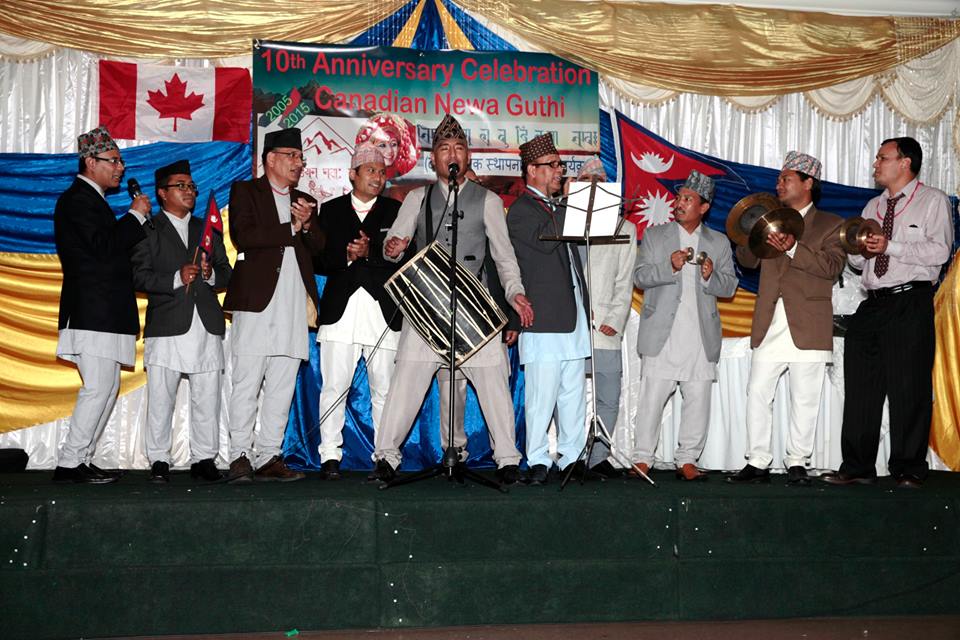
Details: Nepalis from the GTA are coming together to celebrate Mha Puja and Nepal Sambat (New Year). Mha Puja is a cultural event of purification, strengthening and understanding of oneself, and man’s relationship with nature and cosmos. The event by Canadian New Guthi will take place at Brampton Tower Hall, 85 Charolais Blvd. Brampton from 4:30 p.m. onwards. Cost of admission is $25/person (adults) and $15/person (Children 12 and below and seniors).
Contact: Bimal Man Shrestha, 416-705-6672

Wednesday, Nov. 18
nirbhayaEvent: Nirbhaya (play)
Details: Based on the horrific event Dec. 16. 2012 when a medical student was brutally raped and killed, Nirbhaya became a catchphrase in India and elsewhere. Montreal-based writer and director Yaël Farbe and Nightwood Theatre are bringing a riveting play adapted from the real-life events. Play runs from Nov. 18- 29 at the Harbourfront Centre, 235 Queens Quay W. Toronto and stars Priyanka Bose, Poorna Jagannathan, Sneha Jawale, Rukhsar Kabir, Japjit Kaur, Pamela Mala Sinha and Ankur Vikal.
Contact: For tickets, contact here.

Thursday, Nov. 26
Event: Spirit of IndiaSpirit-of-India-Web
Details: Rahis Bharti and the Bollywood Masala Orchestra and Dancers of India invite you on a lively musical journey from Rajasthan to Mumbai. Spirit of India, a musical will happen at The Rose Theatre, 1 Theatre Ln. Brampton at 8 p.m.
Contact: For tickets, contact here.


Canada’s “Bajrangi Behen” brings her magical chants to Toronto

Standard
Canada's Bajrangi Behen Brenda McMorrow seen here with a ascetic on the banks of Ganges. Brenda is a mantra music artist whose music bridges the spiritualism of east with the west. Supplied photo.

Canada’s Bajrangi Behen Brenda McMorrow seen here with a ascetic on the banks of Ganges. Brenda is a mantra music artist whose music bridges the spiritualism of east with the west. Supplied photo.

Years ago, I stumbled upon the haunting sounds of Gregorian Chants and felt a wave of tranquility wash over me, but I did not however set off in the pursuit of mastering the complex Latin verses. Once the moment passed, the memory too fled.

So, when I heard about how Brenda McMorrow began to pursue mantra music after listening to some shlokas few years ago, I simply had to know the why? When? What-on-the-earth for?

Who knew I would have the pleasure of unveiling the identity of Canada’s bona fide Bajrangi Behen.

Good news: you can catch Brenda at a kirtan concert happening in our wonderful city. British Columbia native Brenda McMorrow is the real deal. She can, not only recite the Hanuman Chalisa and other Vedic chants, but can speak about their meaning and relevance.

(For those unfamiliar with Bollywood: In the Hindi blockbuster Bajrangi Bhaijaan, the main character played by Salman Khan is shown as an endearing and ardent devotee of Hanuman aka Bajrangbali).

Brenda’s rendition of the mantra music is upbeat and infused with western influences. But that’s not all. When Brenda is paying homage to the verses, her face radiates with inner peace. Little wonder then that, this Canuck describes herself as a “true bhakt walking along the devotional path of yoga”.

Canadian artist Brenda McMorrow performs at kirtan concerts across the world. Supplied photo

Canadian artist Brenda McMorrow performs at kirtan concerts across the world. Supplied photo

You are probably wondering what would compel a white woman to dedicate herself into learning a dead language (Sanskrit) and gain mastery over it so much so she’s guided through some force of nature to compose, sing, cut records and host Kirtans around the world?

Before her serendipitous introduction to the shlokas, Brenda was rock/folk/bluegrass artist. Then, in 2004, she heard some Sanskrit chants during a yoga workshop. She had no clue what they were, but they stirred something in her.

“The first time I heard mantra chanting, I knew at every level, that that was what I

was meant to do,” she says.

Three years ago, she recorded her version of the Hanuman Chalisa and has since performed it in cities across Europe, Asia, North and South America. In fact, Brenda has recorded two versions of the Chalisa: the windblown and heart version.

Last year, Brenda travelled to Varanasi and was invited to sing the Chalisa on the banks of the Ganges at Tulsi Ghat before the evening’s aarti and later at the Sankat Mochan temple.

“Little did we know that this would be the most enthusiastically participated in rendition of the Windblown Hanuman Chalisa, ever,” she writes about that experience. “Perhaps it had something to do with the fact that we were playing right below Tulsi Das’ residence (the writer of the Hanuman Chalisa).”

On Friday, Sept. 25 Brenda will hosting a kirtan concert at the St. George’s Anglican Church at 410 College St. (one block east of Bathurst) at 8 p.m. Tickets cost S25/person and $35/person (premium).

Also, Brenda’s new album My Heart Bows Down to You, by White Swan Records will be released Sept. 18.

Tickets to the concert can be bought online and via Pay Pal or through www.anahatatimes.com.

Artist takes elements of Rangoli and boy, does he run with it

Standard
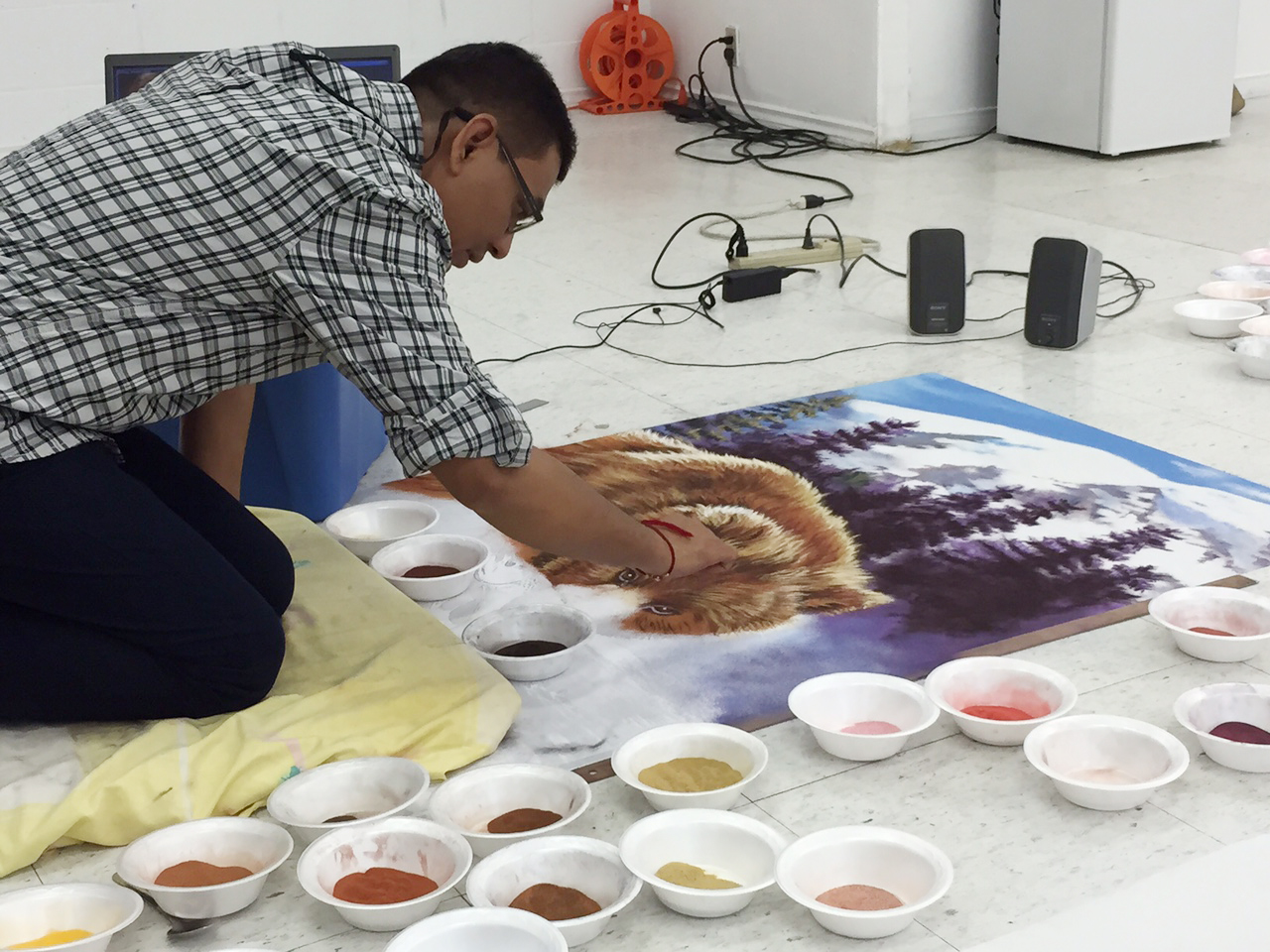
Canadian artist Praksh Shirke fills in the snout of a grizzly bear with coloured sand. Prakash has taken the ancient Indian art of Rangoli and transformed it.

Canadian artist Praksh Shirke fills in the snout of a grizzly bear with coloured sand. Prakash has taken the ancient Indian art of Rangoli and transformed it.

I am no stranger to Kolam or Rangoli as it’s more popularly known. Many of you will know it as Aripana, Madana and Chowkpurna.

Growing up, most mornings, my Mom would wash the courtyard and then do a quick geometric design with powdered rice flour. On special occasions, she would mix the powder in water and do a wet Kolam. That’s the thing with culture; there are always elements that are common to people irrespective of which part of India you come from.

So, when I heard about a Rangoli exhibition by Prakash Shirke, a Canadian artist, I imagined a more elaborate and intricate version of Amma’s kolam.

I was mistaken.

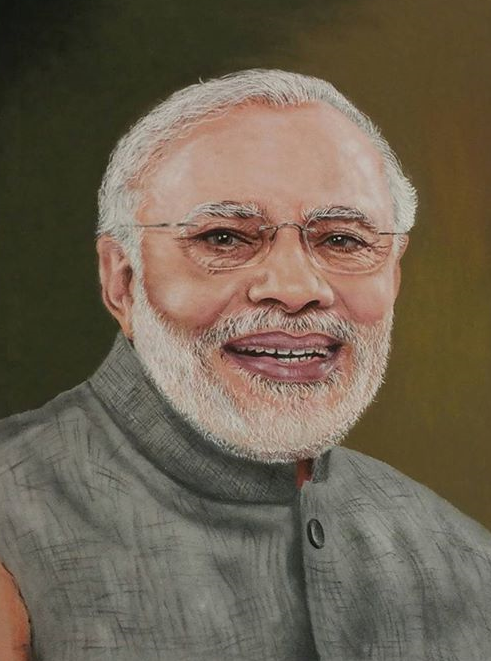
Narendra Modi and Abdul Kalam shared the room with a fierce Grizzly bear and a resplendent sunset or was it sunrise and at the far end was Guru Gobind Singhji? The colourful pieces had photograph-like clarity.

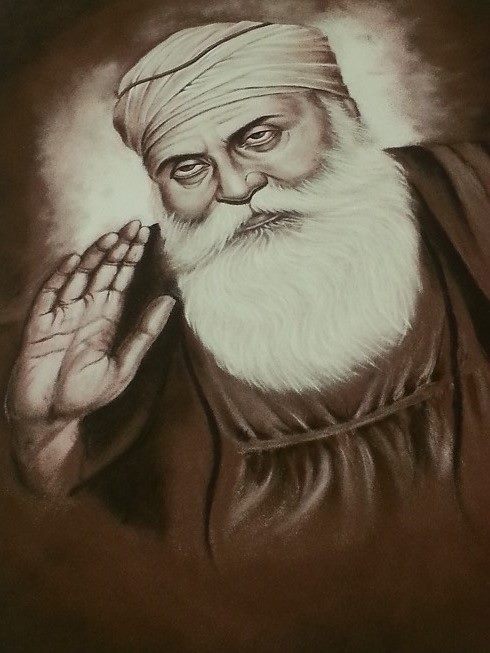
Prakash captures the serenity of Shri Guru Gobind with stunning results. The image was created using powdered sand.

Prakash captures the serenity of Shri Guru Gobind Singhji with stunning results. The image was created using powdered sand.

Prakash is showcasing his stunning sand-art or Rangoli until Saturday, Sept. 13 at 75 Clarence St. in Brampton in a plaza near Kennedy Road and Queen Street. If you have time, check it out. Show hours are: Mon-Fri: 10 a.m. to 2 p.m. and 4 p.m. to 10 p.m. and on the weekend (Sat-Sun), you can watch Prakash draw the Rangoli, 10 a.m. to 10 p.m.

The artist’s eye for details was astounding: He captures the skin tones, the texture of wavy locks of Abdul Kalam’s hair and the predatory gleam on the grizzly’s eyes, not with paint, but sand.

The work was not only intricate, but it required Prakash to spend some 12 hours daily inside a stuffy room (the air conditioner was on fritz) creating art pieces that should ideally be preserved for posterity. Next week, when the exhibit closes, the floor will be Hoovered and wet-mopped leaving no traces of the work that was created there.

“I don’t mind that my art is temporary,” Prakash said. “This means, I can do this again and again…”

That’s an awesome philosophy to hold, especially considering how we humans cling on to everything knowing everything is transient.

Prakash came to Canada some 10 years ago armed with a fine arts degree from Vadodara. We all know, “the struggling artist” is not an oxymoron.

After some odd jobs, Prakash and his wife Vaishali settled down in the GTA, but when a great job opportunity came up in Michigan, Prakash decided to relocate there. He now works as a 3-D animator.

The exhibition had no sponsors or corporate backing. Prakash paid for the supplies, rent for the hall and other expenses out of his pocket.

This was made using coloured sand. Bet, even NaMo will be stumped by the photograph-like effect.

This was made using coloured sand. Bet, even NaMo will be stumped by this photograph-like effect.

Interesting thing: Prakash was initially planning to create a Polar bear, but the white sand, he ordered from India got stuck in customs or some bureaucratic red tape on account of it being white and a powder! So he changed his plans and ended up making a grizzly catching a fish.

“I have done this back home many times, but realized no one has done anything like this here in Canada,” he said. “Many people here don’t even know all this can be done with Rangoli.”

It all starts with Prakash choosing a subject. The idea is to choose a newsmaker that’s relevant and current. Then he powers his laptop and searches for an image or a photograph to replicate with sand. With his laptop perched beside him, the artist then sets outlines the broad strokes and then slowly_pinch by pinch– he starts filling in the form. Like most artists, Prakash is adept at mixing different hues and colours of sands to get the right shade.

Hours of backbreaking work and two weeks later, poof! it’s all gone into the bowels on a vacuum cleaner. But since I am not an artist, I wouldn’t understand, would I?


Phir bhi dil hai Hindustani/Canadian eh? Jake

Standard
Jake Dheer, a prominent desi and well-liked community member. Supplied photo

Jake Dheer, a prominent desi and well-liked community member. Supplied photo

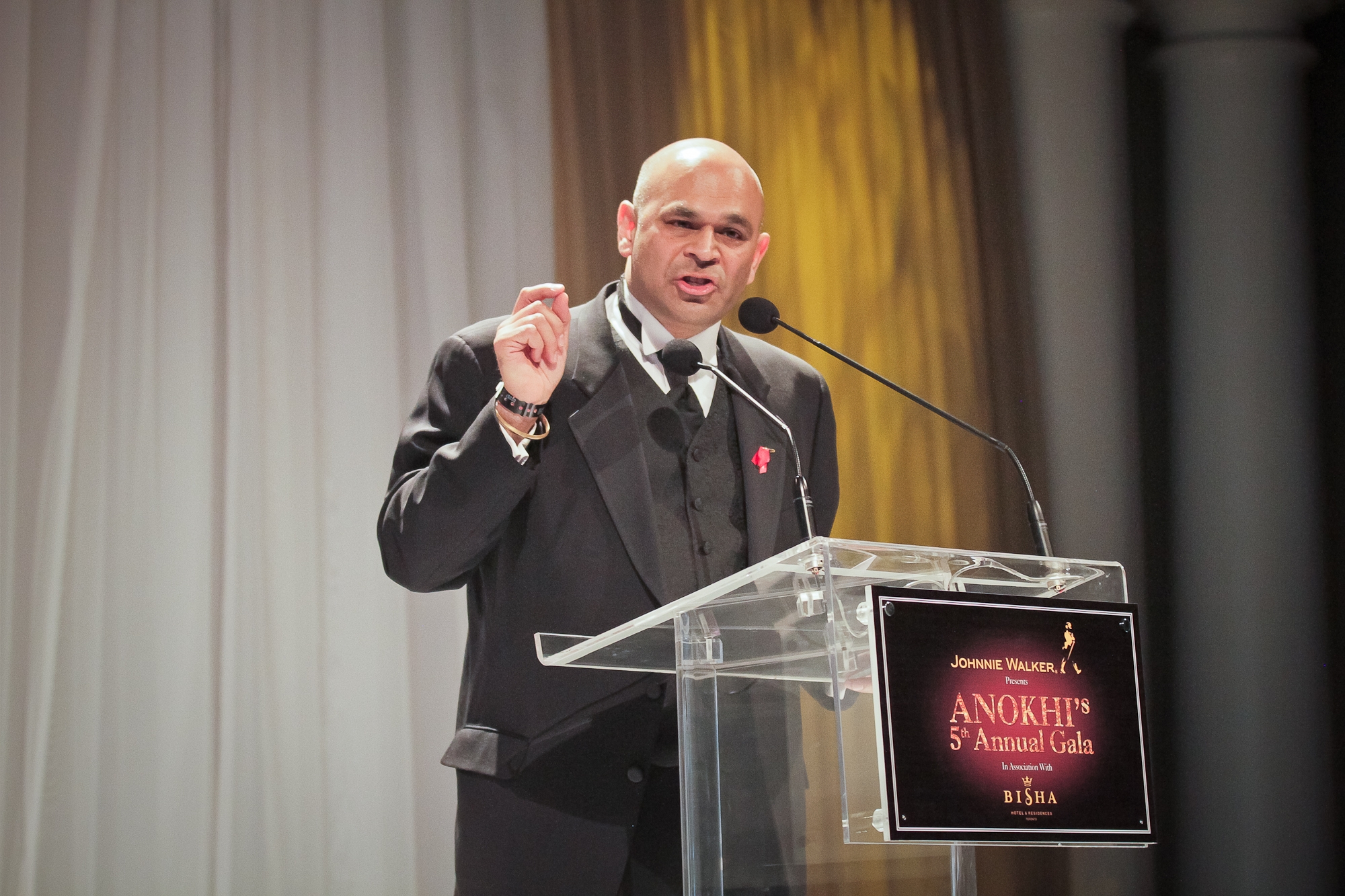
Ladies and gentlemen, that’s right. Welcome to this edition of Toronto Desi Diaries (TDD) where we shine the strobe lights (drum roll, please)— on the well-liked and well-known Jake Dheer, Senior Operations Manager for Rogers Television (Cable 10).

Jake talked about his childhood, spirituality, love of his life (hint: he has more than one), relevance of hyper-local news, success and more. In the interest of space, I have just picked a few.

Some months ago, Jake, one of his colleagues and I were the sole occupants of a media table at a gala event. Our table was wedged between the sound system and the back wall.

At one point during a tedious speech, Jake nonchalantly broke into a song (fortunately, no one could hear his rendition of the slightly off-key Hindi song). Suffice to say, the evening was anything but boring.

Then dinner was served and our table became the VIP one because Jake knew the banquet manager, the wait-staff and everyone else that actually mattered. Dessert was this gooey mouthwatering chocolatey concoction Jake refused because the sweet was garnished with a mound of marshmallows (ingredients include animal protein) him being the staunch vegetarian.

So, let’s rewind the film on Jake’s life, shall we?


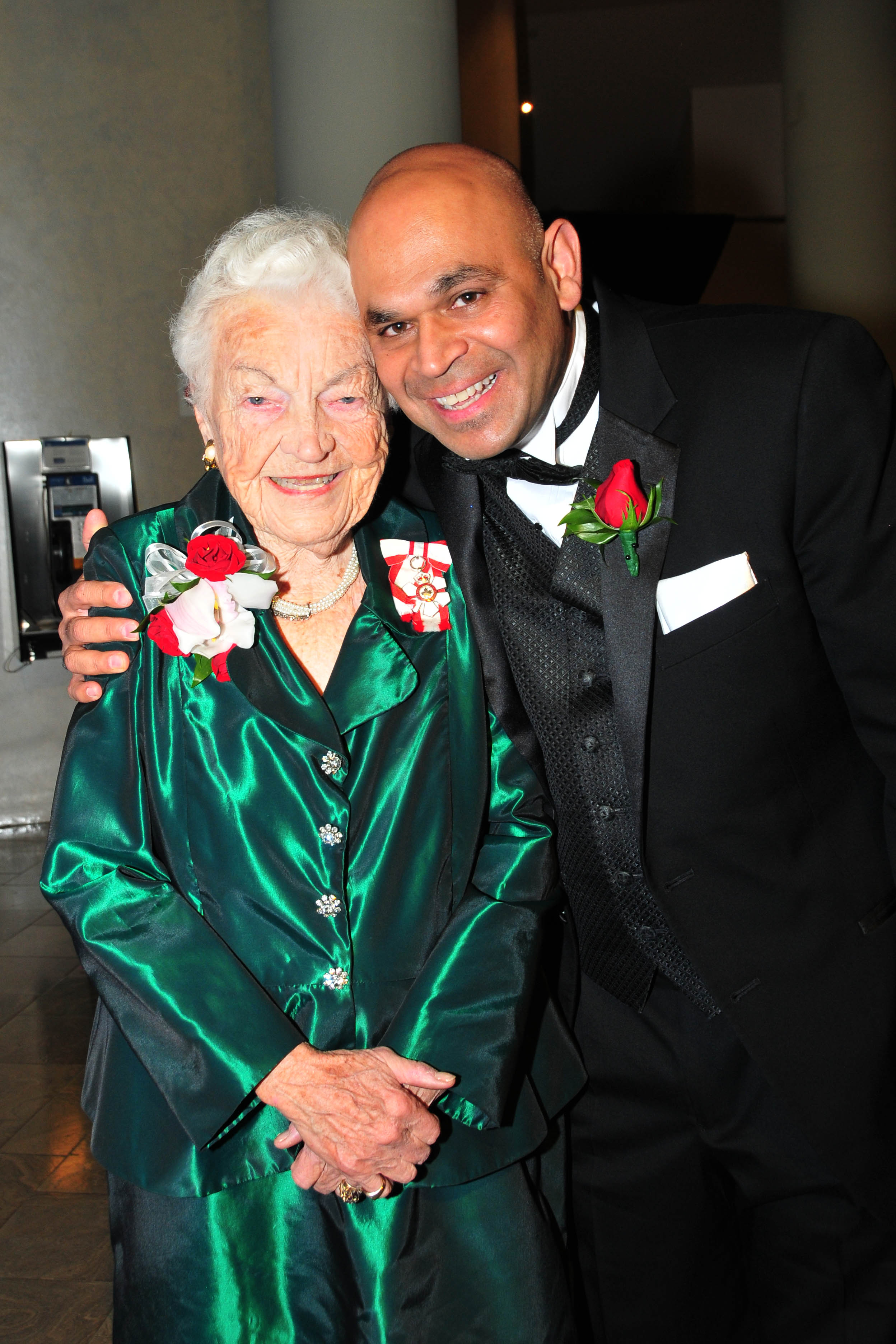
Jake Dheer, senior operations manager, Rogers TV seen here with former Mississauga Mayor Hazel McCallion. Supplied photo.

Jake Dheer, senior operations manager, Rogers TV seen here with former Mississauga Mayor Hazel McCallion. Supplied photo.

Childhood: The celluloid version
Jake’s parents, Ramesh and Gulab, moved to Uganda from Moga (Punjab) shortly after Jake was born however he stayed in India with his grandparents and joined them when he was eight years old. In the early ‘70s when Idi Amin, the dictator, imposed his economic war agenda, the Dheers fled and arrived in Kitchener, Ont.

Jake’s father, a civil engineer, was a visionary businessman. He purchased a theatre and screened Hindi movies on weekends.

“Since my parents were busy eking a livelihood, they did not have time to enroll me in swimming or guitar lessons,” he said. “We children basically fended for ourselves and developed a sense of independence that included me taking on a paper route.”

Kitchener was where the filmmaking bug bit him. Since the theatre was a family affair, Jake was privy to the world of celluloid through osmosis. He wrote and created posters, cleaned halls, manned the concession stand and occasionally became a projectionist.

That theatre also allowed him to get front-row seats to cinema and watch Dev Anand cavorting around trees and Amitabh Bachchan single-handedly beat the bad guys into a pulp.

“I saw how films brought the people and community together,” he said. “I also learned some invaluable business lessons and life lessons from my father. Things like art of persuasion and people management that one can’t learn in any management school.”

Besides Bollywood, Hollywood giants like Steven Spielberg and Francis Coppola influenced the teenager who happily straddled desi and Canadian cultures with ease.

Spirituality: When karma met dharma
When video killed the theatre, Jake joined a national video chain and managed their store. That was his first real job. This led to other sales gigs like selling ads, water filtration system, managing a restaurant and more. All jobs required people skills, something that Jake has in spades. He was hardworking and a quick learner. So, he steadily rose up the ranks.

Then, in 1990, after the restaurant franchise he worked for closed shop, Jake decided to visit India. He had not been to the country of his birth for 21 years. He travelled to the foothills of the Himalayas and lived with his grandparents in a remote village.

“God puts people in your life so you can learn from them,” Jake says of his visit. “The village where I lived had no access roads and it was in a deep valley. Having nothing much to do, I began to read the Bhagvat Geeta (an ancient Indian spiritual text). I had so many ‘aha’ moments. “As I read and understood the words, many things fell in place. It all made sense. I realized your karma is important and once I do my karma, I have to leave the rest to God.”

Jake reads the sacred Hindu text every week. Not just that, he incorporates the principles in his personal and professional life.

Love: What a feelin’
The other equally significant “Geeta” in Jake’s life is his wife of 22 years.

Jake and Geeta’s love story is filmi to boot. So as the story goes, Jake’s parents wanted him to get married and on their trip to India checking out potential candidates, they met the youngest daughter of a family friend they liked and hoped Jake would too.

So, Gulab and Ramesh shot some video footage of the girl and mailed it to their son for approval. When the cassette arrived, Jake set the unopened envelope beside the figure of a deity in a temple in their home.

A month later, the would-be groom, flew to India for his arranged marriage. In India, during a rainy monsoon July, Jake recalls travelling in a palanquin (usually reserved for the bride) through the Himalayan foothills to reach Geeta’s house for the wedding.

Decked in wedding finery and weighed down by a heavy garland with a pendant of Lord Krishna that reached mid-thigh, Jake’s procession set-off. A few kilometres down the road, the groom desperately needed to pee. He whispered his dilemma to a cousin who led him behind an outcrop of rocks and asked him to do his business.

The task was easier said than done because the pajama (chudidar) Jake was wearing had drawstrings that needed some expert maneuvering. Then, the hapless chap had to hold the heavy garland and lift it out of the way of the stream of urine. And above everything, there was the fear of passersby chancing upon the odd sight of an awkward groom trying to relieve himself!

BTW: This incident was way funnier when Jake described it.

Anyway, when Jake finally laid eyes on Geeta—during the ceremonial exchange of garlands — he was smitten. With a wink and thumbs up to his father, he continued to perform the rest of the rituals with a happy grin.

Jake fell hook, line and sinker with his bride with whom he had not exchanged a single word.Jake and Sonia

“I was overwhelmed by the fact that here was a girl who was willing to travel thousands of miles to be with a man she didn’t know and to live with him in an unfamiliar world purely based on the act of simple faith,” Jake said. “I knew then that this woman would stand by me thick and thin. I remember thinking; who am I to judge anyone’s outer beauty when their inner beauty is so pure and radiant?”

Note: Jake teared up when he spoke about Geeta. Jake incidentally has another love – Canada. He loves the country to bits. “Where else can you get the best of both worlds—India and Canada and embrace both,” he asks. “This country allows you to do both, I love Canada for that.”

Over the years, Jake has received many awards, accolades and recognition for his role in media and his  extensive community activism. He was the Mississauga Citizen of the Year in 2005.

Jake lives in Mississauga with his parents, Geeta and their two children, Sonia, 20 and Arjun, 14.


Aakash (sky) is the limit for the company that makes world’s cheapest smartphones

Standard
Suneet Tuli, CEO, Datawind, maker of the world's cheapest tablet/phablet says by seeking out alternate sources of revenue from content, ads and apps, his company is able to sell the devices for less than $40 (CAN).

Suneet Tuli, CEO, Datawind, maker of the world’s cheapest tablet/phablet says by seeking out alternate sources of revenue from content, ads and apps, his company is able to sell the devices for less than $40 (CAN).

This is the second and final part of the two-blog series

When the Tuli family settled in Fort McMurray, Alberta, in the late ‘70s, they were the only Sikh family in town.

Being gawked upon was not uncommon, as was name-calling. However, the four Tuli kids excelled in school and in many ways were gifted. Mother Parveen Kaur, a poet and artist worked at the family’s construction firm and when she was not handling the books there, she immersed herself in her artistic pursuits.

Sikhism was not just a religion for the Tulis. It was a blueprint for life.

In Grade 12, Suneet Singh Tuli, CEO of Datawind, ruffled more than few feathers when he a filed human rights complaint against his school for suspending him because he carried the ceremonial dagger (kirpan) to school.

“In Sikh religion when you get baptized, you’re told Guru Gobind Singh is your father. My mother, grandmother and other elders in the family always emphasized that belief in us,” he said. “Our faith was strong. So, we grew up with a sense that we were special and that created a different mindset.”
He won.

The 10 per cent factor

A few years ago, Raja and Suneet Tuli decided to wade into the turbulent Indian cellphone/tablet market despite knowing fully well the country’s cumbersome bureaucracy and corruption could result in headaches and heartaches. Yet, they went ahead because they wanted to bridge the digital divide in the developing world where an overwhelming number of people live in poverty and have no access to technology.

Remember Suneet’s penchant for gimmicks? That was sort of responsible for Datawind chasing the Indian government to contract it with an order to deliver 100,000 units of Aakash 2 (a low-cost tablet).

The Datawind CEO wanted to set another record, this time for the world’s cheapest tablet. So, the company competed in the bidding. Turns out, Datawind’s bid was 20 per cent cheaper than their closest competitor.

Aakash 2 is cheapest tablet in the world. Even in China, a haven for low-cost components, a similar device sells for $40 and up at least. The android device, unlike its predecessor Aakash 1 has a competent processor and adequate RAM.

Initially, the company ran into trouble as it was unable to fill the order before deadline, but that was only a small setback and it pushed on.

On a quarterly basis, Datawind sells around 900,000 tablets and enjoys 15 to 18 per cent of the total market share for tablets/phablet in India. In the 5,000-rupees segment (low end price bracket), they are the indisputable monarchs as they boast a 55 per cent of the market share.

How on the earth?

Can somebody manufacture a low-cost product and still remain sustainable (financially)?
First off, Datawind makes its own touch screens. The firm set up a thin-film fab in Montreal and in the late 90s Raja decided to make touch panels there. In 2010, the Chinese delivered touch panels for a seven-inch device for approx. $20/piece (CAN), but Datawind was able make the same at their Montreal plant for a fraction of that cost.
Suneet explains the company’s business model focuses on selling its hardware at cost and finding revenue from apps, contents and ads.

Then, there’s Raja’s ingenuity. His technology shifts the burden of processing devices from client servers to back-in servers. So, despite a five per cent margin, Datawind’s low-cost products are not only helping the company’s bottom line, but are also meeting its original premise of making these devices affordable to the masses.

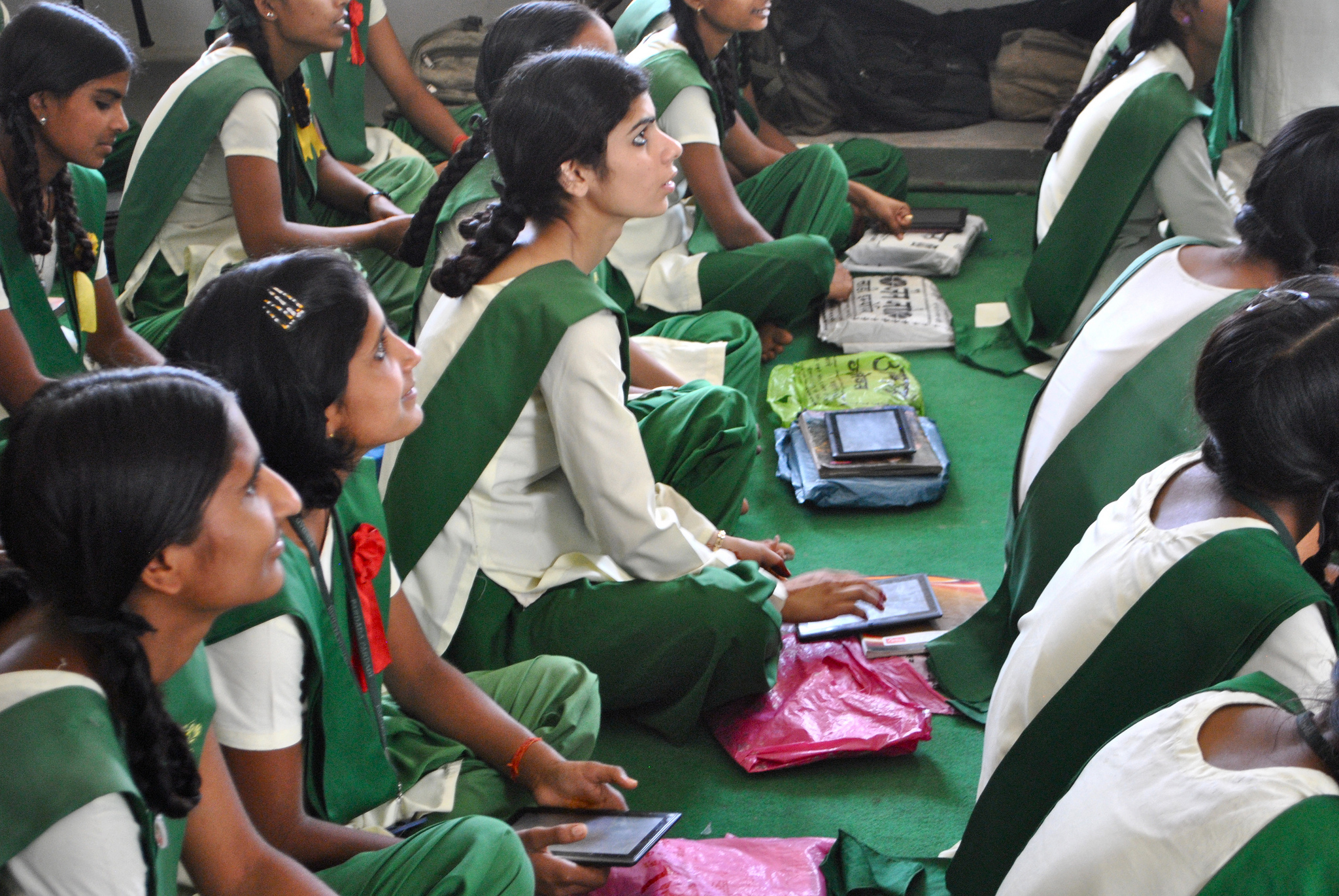
School girls in the state of Rajastan step into the digital age via Datawind's Ubislate tablet, touted to be the cheapest device in the world retailing at under $40 (CAN).

School girls in the state of Rajastan step into the digital age via Datawind’s Ubislate tablet, touted to be the cheapest device in the world retailing at under $40 (CAN).

“It’s not that people can’t make low-cost devices,” Suneet said. “The fact is nobody wants to compete in the entry-level market. I call it the forgotten billions. There are a billion people whose monthly income is less than $200/month. We want technology to be accessible to them. I strongly believe the Internet is the most powerful thing. It will not only educate people, but also empower them.”

One of the tenets of Sikhism urges people to donate 10 per cent of their earnings in acts of charity. Datawind adopted an orphanage in Punjab and donated a bunch of computers to them, but the machines weren’t put to great use, but over the years, Suneet became interested in combining technology and education.

“To me, all this is a very important validation to create awareness that we can survive on low-cost devices and to evangelize the benefit of having affordable devices and technology and the impact it has on education,” Suneet told TDD. “This (cheapest tablet/phablet) was my gimmick, the equivalent of the Guiness World Record we attempted years earlier.”


If fax machines could talk: The Datawind story

Standard
Raja and Suneet1

Raja (L) and Suneet Singh Tuli are brothers with a Midas touch. Their Canadian company, Datawind, has bridged the digital gap with its affordable devices. Supplied photo.

Some people equate their net worth with their self-worth.

Suneet Singh Tuli doesn’t need constant validation from the tech-industry to acknowledge the impressive feats his company Datawind has pulled off since it was founded.

The Tuli family’s spirit of enterprise grounded in deep-rooted spirituality powers not their devices, but the company’s strong corporate social responsibility (CSR) initiatives as well.

Datawind’s UbiSlate tablet—which retails at $37.99 — may not enjoy the same cult status the Apples and Samsungs do, but, it’s safe to say the devices are transforming the lives of the millions of people in developing countries by giving them access to technology.

Whenever an email from a remote school in Uganda or India with photographs of children holding a UbiSlate device lands on his inbox, Suneet, 46, says he feels a sense of fulfillment.

“When your business impacts something or someone, then it becomes fun,” Suneet said. “The real satisfaction comes when you can get people connected and excited about technology.

Suneet’s says although he’s the face of the company, his intensely private older brother, Raja, 48, is the one whose idea it was to come up with a low-cost tablet.

The Garage Story

So many tech startups in Silicon Valley and elsewhere can trace their origins to ubiquitous garages. These windowless spaces have served as an incubator to rock stars and tech mavericks alike.

For starters, the Datawind’s Garage Story did not start in the garage. It began in Yukon.

The Tulis immigrated from Iran in 1979 and put down roots in Fort McMurray, (Alberta). Lakhbeer Singh Tuli (Suneet and Raja’s father) started a construction company that primarily built bridges in remote areas of Canada. His sons, Raja and Suneet, spend their summers working for their dad.

One of the sites was in Pelly Crossing in Yukon.

One summer, the ever-perceptive Raja, noticed staff cutting strips of technical drawings, individually feeding them into the fax machine, and then gluing the pieces together.

Raja was convinced there had to be a better way. So, he hit upon the idea to build a large fax machine from scratch. He sourced the materials, designed and assembled it. This fax machine one could accommodate large format engineering drawings without mutilating them.

Raja, who was a fresh graduate, approached his dad to loan him the seed money to commercially market the “world’s largest fax machine.”

Tuli Sr. agreed to fund the enterprise. The fledgling company (Widecom) then hired experienced sales guys to market the product, but six months into the venture, sales went cold.

At this point, Suneet, a natural salesman, was pursuing his engineering degree at the University of Toronto. He suggested to Raja they contact the Guinness Book of World Records (GBWR) and submit the fax machine for consideration as the world’s largest fax machine. Raja was initially skeptical, but Suneet convinced him.

The fax machine made it into the silver book.

Then everything unfolded seamlessly. Fortune 500 magazine devoted a quarter-page to the Tuli brothers and their ingenuity. Some weeks later, British Petroleum (BP) placed an order for 12 machines, each costing $20,000 each.

“In 1992, there were no prominent desis (Indians) in either Wall Street or Bay Street,” Suneet said. “Worse, there was a backlash against turbaned people (with flowing beards) because of the Iranian Revolution. So, when the fax machine took off, we represented a “Made in Canada” success story, a story, featuring young immigrant kids that had succeeded against all odds.”

The Tuli brothers were in their mid-20s when they made their first million, or rather $8 million.

The wide-format fax machine was a timely innovation and a huge hit. The brothers floated WideCom on NASDAQ. Corporate giant Xerox expressed interest in acquiring the company, but the Tuli brothers passed on Xerox’s offer.

In hindsight, one can bemoan their decision was a bit short-sighted, however, in the long run, it helped Raja and Suneet to explore new and emerging technologies, instead of resting on one laurel.

The brothers launched Datawind Inc. in 2000.

“We always had our father’s support and learned from his willingness to lose and risk things,” Suneet said. “Our father paid for our tuition and the seed fund for the fax machine. Having his backing told us, it was OK to risk and lose. But, that early success also provided us with confidence.”

Stay tuned. In the next part, Toronto Desi Diaries will reveal how the world’s least expensive tablet/phablet has been able to connect profit margins with philanthropy.