If fax machines could talk: The Datawind story

Standard
Raja and Suneet1

Raja (L) and Suneet Singh Tuli are brothers with a Midas touch. Their Canadian company, Datawind, has bridged the digital gap with its affordable devices. Supplied photo.

Some people equate their net worth with their self-worth.

Suneet Singh Tuli doesn’t need constant validation from the tech-industry to acknowledge the impressive feats his company Datawind has pulled off since it was founded.

The Tuli family’s spirit of enterprise grounded in deep-rooted spirituality powers not their devices, but the company’s strong corporate social responsibility (CSR) initiatives as well.

Datawind’s UbiSlate tablet—which retails at $37.99 — may not enjoy the same cult status the Apples and Samsungs do, but, it’s safe to say the devices are transforming the lives of the millions of people in developing countries by giving them access to technology.

Whenever an email from a remote school in Uganda or India with photographs of children holding a UbiSlate device lands on his inbox, Suneet, 46, says he feels a sense of fulfillment.

“When your business impacts something or someone, then it becomes fun,” Suneet said. “The real satisfaction comes when you can get people connected and excited about technology.

Suneet’s says although he’s the face of the company, his intensely private older brother, Raja, 48, is the one whose idea it was to come up with a low-cost tablet.

The Garage Story

So many tech startups in Silicon Valley and elsewhere can trace their origins to ubiquitous garages. These windowless spaces have served as an incubator to rock stars and tech mavericks alike.

For starters, the Datawind’s Garage Story did not start in the garage. It began in Yukon.

The Tulis immigrated from Iran in 1979 and put down roots in Fort McMurray, (Alberta). Lakhbeer Singh Tuli (Suneet and Raja’s father) started a construction company that primarily built bridges in remote areas of Canada. His sons, Raja and Suneet, spend their summers working for their dad.

One of the sites was in Pelly Crossing in Yukon.

One summer, the ever-perceptive Raja, noticed staff cutting strips of technical drawings, individually feeding them into the fax machine, and then gluing the pieces together.

Raja was convinced there had to be a better way. So, he hit upon the idea to build a large fax machine from scratch. He sourced the materials, designed and assembled it. This fax machine one could accommodate large format engineering drawings without mutilating them.

Raja, who was a fresh graduate, approached his dad to loan him the seed money to commercially market the “world’s largest fax machine.”

Tuli Sr. agreed to fund the enterprise. The fledgling company (Widecom) then hired experienced sales guys to market the product, but six months into the venture, sales went cold.

At this point, Suneet, a natural salesman, was pursuing his engineering degree at the University of Toronto. He suggested to Raja they contact the Guinness Book of World Records (GBWR) and submit the fax machine for consideration as the world’s largest fax machine. Raja was initially skeptical, but Suneet convinced him.

The fax machine made it into the silver book.

Then everything unfolded seamlessly. Fortune 500 magazine devoted a quarter-page to the Tuli brothers and their ingenuity. Some weeks later, British Petroleum (BP) placed an order for 12 machines, each costing $20,000 each.

“In 1992, there were no prominent desis (Indians) in either Wall Street or Bay Street,” Suneet said. “Worse, there was a backlash against turbaned people (with flowing beards) because of the Iranian Revolution. So, when the fax machine took off, we represented a “Made in Canada” success story, a story, featuring young immigrant kids that had succeeded against all odds.”

The Tuli brothers were in their mid-20s when they made their first million, or rather $8 million.

The wide-format fax machine was a timely innovation and a huge hit. The brothers floated WideCom on NASDAQ. Corporate giant Xerox expressed interest in acquiring the company, but the Tuli brothers passed on Xerox’s offer.

In hindsight, one can bemoan their decision was a bit short-sighted, however, in the long run, it helped Raja and Suneet to explore new and emerging technologies, instead of resting on one laurel.

The brothers launched Datawind Inc. in 2000.

“We always had our father’s support and learned from his willingness to lose and risk things,” Suneet said. “Our father paid for our tuition and the seed fund for the fax machine. Having his backing told us, it was OK to risk and lose. But, that early success also provided us with confidence.”

Stay tuned. In the next part, Toronto Desi Diaries will reveal how the world’s least expensive tablet/phablet has been able to connect profit margins with philanthropy.


Burq Off! unveils hypocrisy with humour

Standard
burq4

Burq Off! a show by Brooklyn native Nadia Manzoor is a hilarious commentary of a young girl’s search for identity in two opposing cultures: modern London and her Muslim upbringing. The show runs March 18-21 at Small World Music Centre, 180 Shaw St. Studio 101 in Toronto. Photo by John Keon.

Warning!

If you’re a buttoned-up prude easily offended by people that rip-off the band-aid on religion and hypocritical zealots who preach it, stop right here. Don’t bother reading this further.

Nadia Manzoor is an actor, artist, activist and rebel. Her upcoming show Burq Off! running at Small World Music, 180 Shaw St. in Toronto, March 18-21 has elements that will likely: a)make you squirm b)pray for salvation c) prompt you to speed dial the religious/moral police  D) remove the cobwebs from you mind and eyes  E) Provide a compelling, yet hilarious commentary of the changing times and religion’s inability to keep up.

The show’s brand of humour will either shock the audience into silence or tickle their funny bone until they are a helpless mass of mirth sprawled on the floor.

Nadia, a Brooklyn native landed in North America via Karachi, Singapore, Dubai and Hertfordshire, U.K. pokes fun of misogynist men, antiquated customs, silly rituals and our insecurities about the west.

BURQ OFF! THE SHOW

In Burq Off! Nadia pulls off 21 characters: a stern father, a saucy English friend, Islamic studies’ teachers and few dozen others. The show reveals the cultural tug-of-war of a young Muslim straddling two cultures that are completely at odds with each other — the modern woman versus the dutiful Muslim daughter.

“My struggle in Burq Off! is about reconciling my conservative upbringing with my own liberal questioning,” Nadia said. “At the time, it seemed I couldn’t have stayed true to my ‘religion’, or at least the way I was taught religion, and my own independent thought and inquiry. As a result I felt like I had to step away from those definitions.”

Nadia Manzoor with her Dad, Parvez. Nadia's one-woman show Burq Off! pokes fun at her father's conservative ideas which often clashed with her own modern views. The show runs March 18-21 in Toronto. Submitted photo.

Nadia Manzoor with her Dad, Parvez. Nadia’s one-woman show Burq Off! pokes fun at her father’s conservative ideas which often clashed with her own modern views. The show runs March 18-21 in Toronto. Submitted photo.

A witty banter between Nadia and her father Parvez many moons ago describes the premise of Burq Off!
When Nadia was old enough to realize the world was hers for taking, she announced to her Dad she wanted to become an astronaut.

“Request denied; God is great. Who will cook for your husband?” her Dad rued?

Growing up in a predominantly white neighbourhood and attending a Christian school meant a constant tussle and confrontation at home.

BEING HUMAN

“It seemed like what was more important at the time was how other people defined you,” Nadia recalled. “If you were dating a white Irish man, you couldn’t have been a very good Muslim. But in my heart, I was deeply connected with the divine and have always been. But people label you and define you according to their own set of beliefs, so stepping away from my ‘religion’ and culture was really me stepping away from the people that kept trying to define me. I needed to define myself.”

In a world torn by religious strife and unnecessary chest thumping, Nadia’s show brings a fresh and necessary perspective to the stale debate about religious freedoms.

“Liberal Muslims are definitely under represented, and the orthodox people get all the attention, and also by proxy end up defining people’s understanding of the religion,” she says. “Can you be a Muslim and date a white guy and wear bikinis and drink alcohol?”

 NIRVANA THROUGH HUMOUR

Humour was Nadia’s coping mechanism growing up. It has since become her livelihood, arsenal to deliver punches and life’s calling.

“In every way imaginable. I’ve found my purpose,” she said. “Not meaning to be all existential, but the first time I performed there was this moment when everything in my life, and all the struggle, and everything that I had done until that moment just made sense. It was like finding my calling. As a result I have a newfound confidence in why I’m here and why I exist. If that’s not transformational, I don’t know what is. My whole life has become about continuing to use my creativity for change….”

LIGHTS, SET, ACTION

Burq Off! a one-woman show by Brooklyn native Nadia Manzoor who plays 21 different characters will run March 18-21 at Small World Music Centre, 180 Shaw St. Studio 101 in Toronto.

Burq Off! a one-woman show by Brooklyn native Nadia Manzoor who plays 21 different characters will run March 18-21 at Small World Music Centre, 180 Shaw St. Studio 101 in Toronto.

Tara Elliot, the director and one of the co-producers, hit it off with Nadia when their paths crossed. As a one-woman show, Nadia carries Burq Off! on her shoulders with relative ease, but to make the show as an interactive experience, Tara had to make sure Nadia’s storytelling was enhanced.

“I wanted to create a playground for Nadia that was visually engaging, transformative, and yet aesthetically simple,” Tara said. “Fabric is easily transformable, and so it became a part of the storytelling in my mind at a pretty early point. Then, through play and experimentation in rehearsal, I found that the use of fabric was all we needed regarding props and costumes in order to portray the range of characters and situations. The set of fabric is beautiful and rich, but also perhaps, restrictive. It is layered, and as with all layers, one might ask the question of what it is covering up…”

Paprika Productions will stop by Toronto for shows at Small World Music, 180 Shaw St. in Toronto from March 18-21. Two matinee shows have been added now. Tickets cost $25/person and can be purchased here.

How a gay Hindu wedding in Toronto changed the conversation

Standard
Rishi (left) and Dan married in 2011 in a traditional Hindu wedding. The couple are talking about their same-sex wedding and their individual journies in the hopes of creating awareness about LGBT issues. Supplied photo.

Rishi (left) and Dan married in 2011 in a traditional Hindu wedding. The couple are talking about their same-sex wedding and their individual journeys in the hopes of creating awareness about LGBT issues. Photo courtesy of Channa Photography.

Daniel Langdon and Rishi Agarwal’s love story is not a one-dimensional, linear relationship of two gay men falling in love and getting married.

Instead, when you analyze their relationship from the perspective of the society, cultural norms and religion, the central characters of this saga are not the two grooms, but, the Hindu priest that risked condemnation of his peers to perform all the rituals; Rishi’s parents – Vijay and Sushma – whose acceptance and unconditional love will hopefully help change the narrative of homosexuality within the Indian community here in North America and Daniel’s family who embraced Rishi and his culture.

These folks put aside their own pre-conceived ideas just so Rishi and Dan could experience the same happiness a heterosexual couple would have under similar circumstances.

RELIGION: Growing up in a Hindu home, Rishi learned the traditions by osmosis. As a kid, he was was bullied. He remembers coming home from school; heading straight to the mandir (temple) in his home and breaking down in front of the deity.

“Faith was very important for me,” Rishi said. “It helped me get through all of the struggles I went through as a child. My connection to that (force) we don’t fully understand is through Hindu rituals. So, for me to have a wedding and it not be a Hindu wedding was impossible.”

Daniel and Rishi were married in 2011, so why are we telling this now? This story is timeless because the couple realizes the enormous challenges gay people around the world face. The two accountants living in Toronto are aware that for individuals identifying themselves as gay within the desi community, the road is uphill.

Many choose to remain in the closet fearing the wrath of parents and the community. Rishi and Dan said they want to open a dialogue on homosexuality, religion and acceptance to prompt a social change.

It has been three years since their Big Fat Gay Hindu Wedding, but theirs may have been the only gay Hindu wedding to incorporate all elements of tradition, culture and the whole nine yards. There have been no others since then. Even though religion was not a huge factor in Dan’s coming out, he knew as soon as he connected with Rishi that Hinduism would be an integral part of their wedding and life afterwards as a married couple.

It takes a family to make a wedding memorable. From L to R: Vijay, Rishi, Dan and Sushma at the same-sex Hindu wedding of their son, Rishi with Dan. Supplied photo.

It takes a family to make a wedding memorable. From L to R: Vijay, Rishi, Dan and Sushma at the same-sex Hindu wedding of their son, Rishi with Dan. Photo courtesy, Channa Photography.

“I really like Hinduism,” Dan said. “It has a very open-minded approach to practicing it and it’s inwardly reflective. What I like is that the rituals are prescribed, but the actual thinking –at least from my experience –isn’t. So, it’s up to the individual to make that connection…”

WEDDING: Rishi remembers the day he came out to his parents. At first, they were speechless and sat in stunned silence. Then, they spent the next 72 hours researching and reading about homosexuality and trying to educate themselves. So, when a nervous Rishi, tentatively asked his parents if they expected him to move out of the house, his father told him, “Absolutely not. You’re still our son and we love you…”

His parents’ acceptance made Rishi’s journey that much easier, unlike so many others. In high school, Rishi knew of a gay Sikh boy who committed suicide when his parents refused to accept his homosexuality. Rishi and Dan’s wedding was a magical affair with all the bells and whistles. The Sangeet took place at the Agarwal house and Dan’s family put together a musical along the lines of 12 Days of Christmas.

The grooms had matching henna motifs of the other person’s initials. During the planning of the wedding, several Hindu priests turned down the Agarwals, finally, a maharaj ji, agreed to perform the rituals. It was poignant, memorable and a path-breaking affair. The garlands were sewn with red and white roses accented with blue and green orchids. The grooms looked resplendent in Sherwanis. Dan opted for a pale blue one with silver sequins while Rishi chose gold and crimson attire.

JAI AND VEERU: In 2013, the couple made a trip to India, and rather than explain their relationship to tour guides and hotel concierges, Rishi told everyone he and Dan were like Jai and Veeru of Sholay. That description was so apt and universally well received that it made a mystic journey to a land where homosexuality is frowned upon smooth and hassle free.

HUMOUR: I knew Rish and Dan were made-for-each other when 10 minutes into our conversation, Dan delivered a “baniya” joke with a straight face. It was when I asked them their plans for Valentine’s Day and Dan replied, “We don’t believe in Valentine’s Day, but since we are baniyas, we will probably celebrate it the next day!” FYI (In India, the Baniya community, which the Agarwals belong to are made fun of for their tight-fistedness).

In 2011, Dan and Rishi, had a gay Hindu wedding that succeeded in breaking stereotypes. Today, the couple are telling their story in the hopes of creating awareness. Supplied photo

In 2011, Dan and Rishi, had a gay Hindu wedding that succeeded in breaking stereotypes. Today, the couple are telling their story in the hopes of creating awareness. Photo courtesy of Channa Photography.

And so, when the talk of cuisine came up, Rishi gleefully narrated the story of how an unsuspecting Dan ended up taking a big bite of the spicy Indian jalapeno peppers (known as green chillies) that his Mom had garnished the yoghurt dip with. He assumed they were string beans and quite literally turned a deep shade of crimson.

Mirth aside, the two Torontonians, who met online and fell in love, know they are fortunate.

“I am happy and proud to be Canadian because we are in the forefront when it comes to gay rights,” Rishi said. “Also, I am proud to be living in Toronto because we have such a large Indian community that we were able to arrange for everything (for a wedding). To have a gay Hindu wedding is not something that can be done in any city in the world…”

“There’s also a big unspoken part that people don’t speak about and that is the limited understanding and acceptance about gay issues. I think in Toronto and the rest of the world, there still needs to be a greater awareness about LGBT issues. We need a lot more education,” he said. “A lot of couples will do a court marriage, the difference in our case was: we had our parents’ support. You cannot do a Hindu wedding without family and friends…”

If you like art that’s edgy, then you’ll love Vishal Misra’s work

Standard
Vishal Misra, an accomplished artist/illustrator seen here with his work. The Toronto accountant has successfully made a name for himself here in North America with his works. Supplied photo.

Vishal Misra, an accomplished artist/illustrator, has successfully made a name for himself here in North America with his works. Supplied photo.

Before you read on, I want you to:

Mentally strip all existing artwork from the walls of your favourite room; ditch the decorative curios, collectibles and what not crammed in the tables and sideboards.

Then, in your mind’s eye, visualize a Vishal Misra art (large acrylic canvas featuring a subliminal Indian theme) placed strategically at eye-level.

Each time I have performed this exercise, I have been stunned by how Vishal’s work can complete any space with its hypnotic presence. The room doesn’t need anything else to embellish it.

Here’s neat thing; one doesn’t have to be a connoisseur of art or schooled in some aspect of it to appreciate the lines and the stroke of his brush and the harmony of colours.

Vishal’s repertoire of subjects spans the breadth of human consciousness. Spiritualism, eroticism and street scenes from India are all elevated into abstract pieces that speak to you on a visceral level.

Recognize a whiff of Picasso or M.F. Hussain in Vishal’s work? That’s incidental. The Toronto artist/illustrator admits he’s self-taught and heavily influenced by the cubistic styles of the two masters.

During the day, this transplant from Mumbai, handles numbers, financial projections and audits. In the evenings and weekends, he transforms into an all-consuming artist completely lost in the pigment of his imagination. Yes, that’s a “pigment” not figment.

“As an accountant and artist, I balance two lifestyles,” Vishal says. “Between 9 a.m. to 5 p.m. the left brain is boxed in with rules, regulations and numbers, but then when I am on the GO Train and I get my hands on a blank page, I feel can do whatever I want and let the right brain take over.”

Well, it was in the train Vishal realized the potential of his talent.

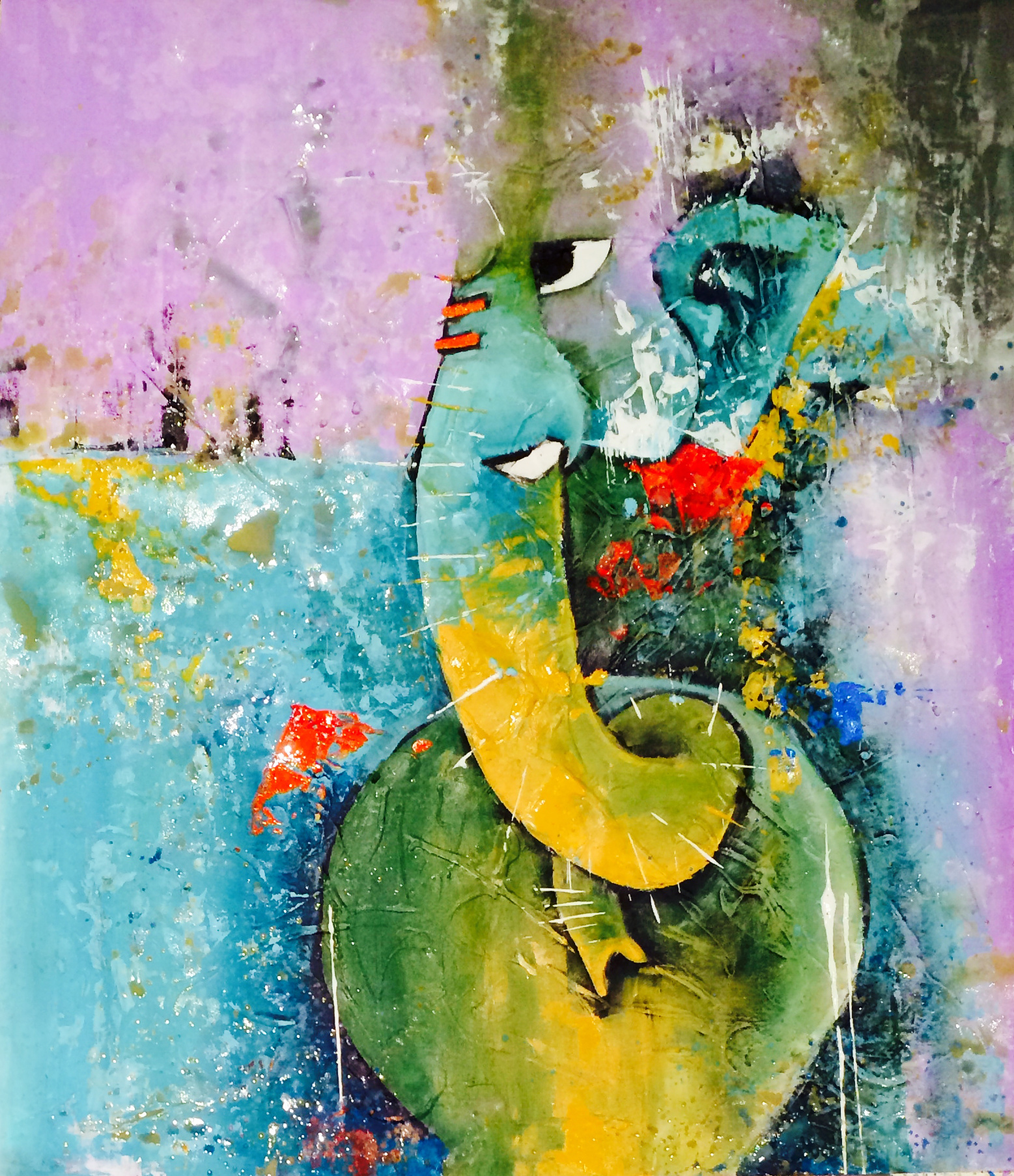
Vishal Misra, a transplant from Mumbai, has a deep connection with Lord Ganesh. His interpretation of the Elephant God elevates the piece. Vishal, a well-recognized artist commands four-figure numbers for his artworks and is well-known in Toronto. Supplied photo.

Vishal Misra, a transplant from Mumbai, has a deep connection with Lord Ganesh. His interpretation of the Elephant God elevates the piece to a subliminal experience. Supplied photo.

A few years after Vishal immigrated to Canada, he was on the train, doodling away and oblivious to his surroundings when a fellow passenger asked him if he would give her the sketch he was working on. Vishal refused. The woman persisted and then offered him $50.

“The accountant in me became interested when she offered the money,” he recalled. “That was the first time I realized that people would actually pay for my art.”

Born to middle-class parents, Vishal grew up in Mumbai. Even though his Dad dabbled in art (purely as a hobby), his parents believed academics was the only thing that mattered. And like every other South Asian parents on the planet, the Misras too wanted their son to become either a doctor or an engineer.

When Vishal landed in Toronto, he went back to school, upgraded his education and soon after landed a job with a well-known accounting firm. At this time, he began to reconnect with the easel and the brush and became a member of the Mississauga Arts Council (MAC). The consortium helped him to grow, network and interact with other artists.

Over the last eight years, Vishal’s works have graced the walls of numerous solo and group exhibitions in Canada, the U.S., Asia, Middle East and Europe. Some of his bigger works currently command four figures and an artist, Vishal is well recognized here in North America.
In 2005, Vishal met and married Anu Vittal, an artist as well and began to articulate his emotions through art. In Anu, Vishal found his muse. Sketches with underlying tones of eroticism soon began filling his sketchbook.

“I wanted to explore the idea of a human relationship and how it grows, evolves and continues,” he explained. “Sexuality is a big part of that because it represents an intersection of emotional and physical aspect of the relationship.”

Vishal then decided to interject contemporary and western-style elements to traditional Kama Sutra images. His fresh linear look offers a new perspective to century-old art.

Toronto native Vishal Misra took the traditional positions of Kama Sutra, an ancient Indian tome on sexuality and added a modern and contemporary twist to it.
Supplied photo.

“I wanted the sketches to be both evocative and provocative,” he said. “I interplay the interaction of various positions of the male and female form beyond the realm of black and white.”

In each and every piece, Vishal infuses his art with his interpretation of events. He begins by capturing an idea then distorting it so that the viewer sees in it what they want to see.

You can take a peek at Vishal’s portfolio here.


Brar’s hits a sweet spot for desis during Diwali

Standard
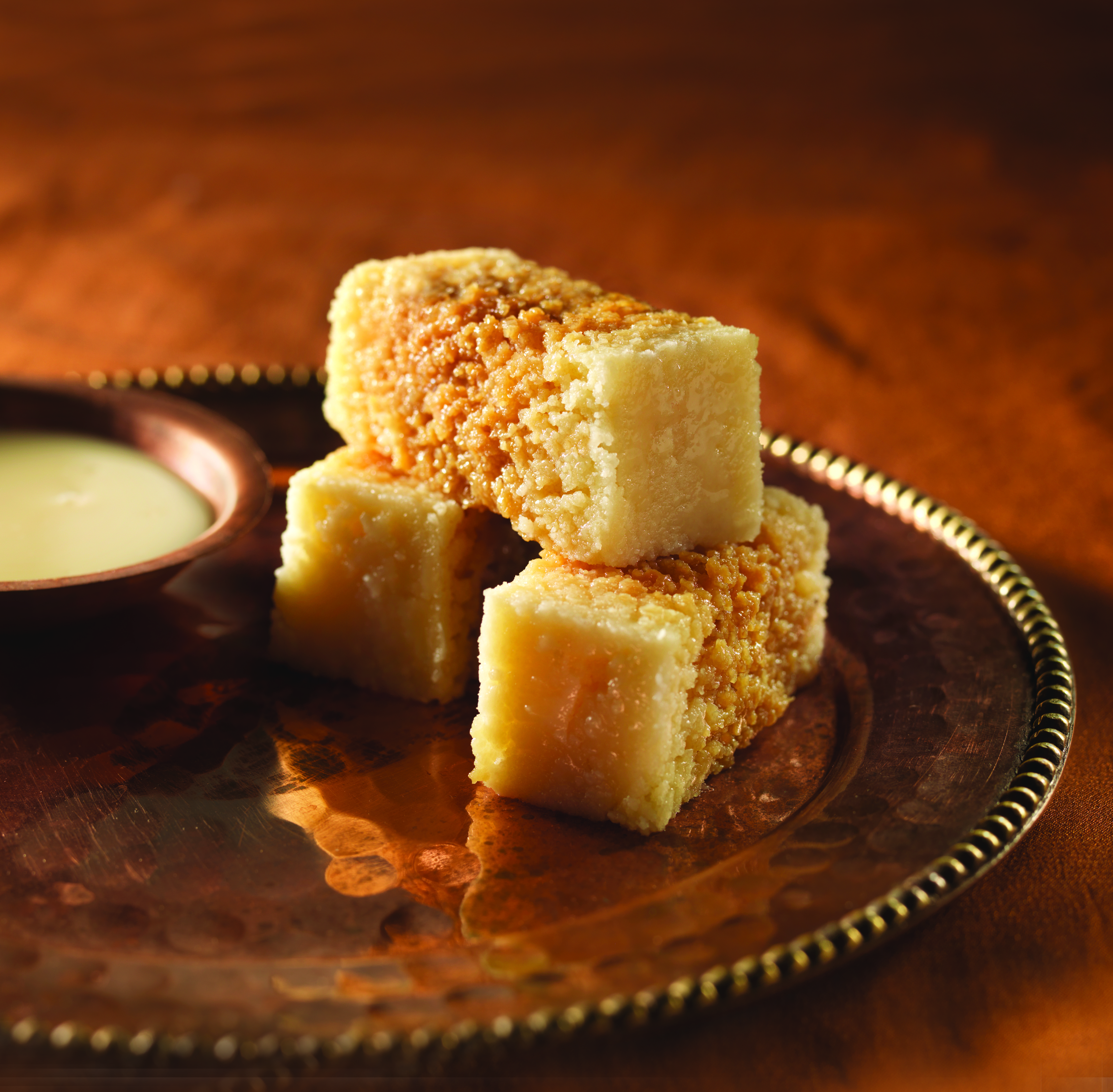
Brar's, a popular restaurant and sweet shop, is famous for it's milk cake. This Diwali the company has produced 175,000 lbs. of food/sweets for Diwali

Brar’s, a popular restaurant and sweet shop, is famous for it’s milk cake. This Diwali the company has produced 175,000 lbs. of food/sweets in anticipation of Diwali. Photo courtesy Brar Food Culture of India

Thirteen years ago, when my family and I landed in the True North, that first Diwali, a few of us piled on to our cars and drove some 35 kilometres to Gerrard Street. It was a tired and dated boulevard some of you know as “Little India.” The experience lacked the characteristic boisterousness of  celebrations back home.

Today, it’s a completely different landscape in the Greater Toronto Area (GTA). There are dozens of ethnic stores, smack dab in our neighbourhoods offering stunning diyas (earthen lamps), fireworks and mouth-watering mithai (sweets). You can fill all of the delicious confectionery in designer gift boxes embellished, with colourful stones and beads.

In the next few days, some of us will likely make a trip to Brar’s, an iconic restaurant/sweet shop to pick-up their signature milk cake, both regular and the chocolate infused version, motichoor ladoos and other assorted barfis.

Dial Pabla, 65, founder of Brar’s Food Cultures of India, eldest of seven children, landed in Canada in 1979 and set about translating his dream into a multimillion business. Today, that business spans across five countries. This is his story.

*****

Competing restaurateurs have tried sneaking their chefs into Brar’s  in an effort to decode the recipes, but these folks have met with little success.

That’s because the special ingredients, the proportion and processes are all a well-guarded secret, and kept under lock and key.

Dial, who tweaked the original recipes with his ingenuity, can afford to be smug because the recipes are a result of years of innovation and creativity. They cannot be replicated with a mere taste test. God knows, many have attempted.

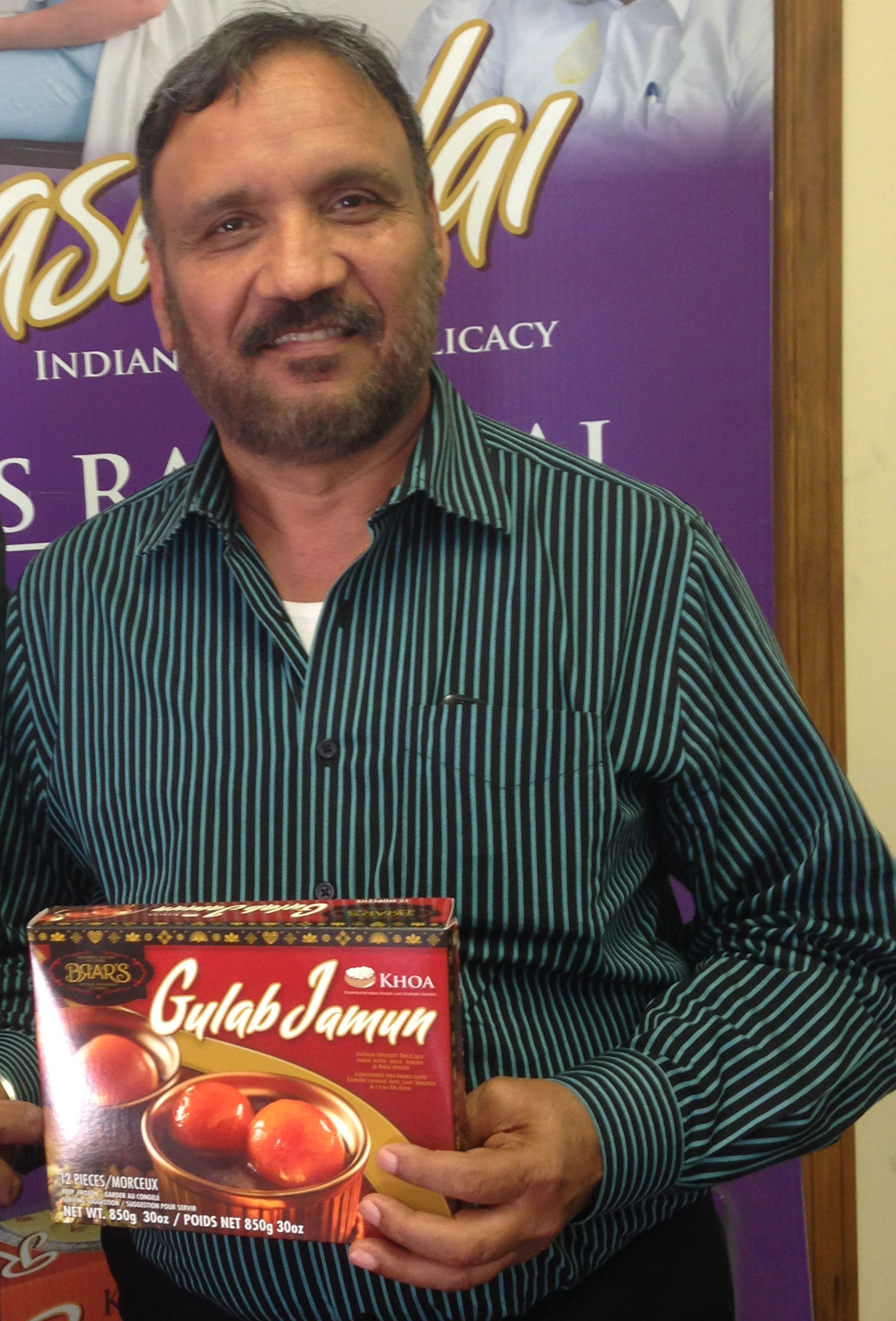
Dial Pabla, founder/owner of Brar's Food Culture of India started the company in the early '80s with one small store. Today, his empire extends to multiple restaurants and a manufacturing plant as well. Photo courtesy of Brar's Food Culture of India.

Dial Pabla, founder/owner of Brar’s Food Culture of India, started the company in the early ’80s with one small store. Today, his empire extends to multiple restaurants and a manufacturing plant as well.
Photo courtesy of Brar’s Food Culture of India.

“Our mithai is revolutionary because other people cannot knock-off our mithai,” Dennis Pabla, Dial’s son said. “My dad has used secret ingredients and has special formula.”

Pabla built his empire based on his love for food.  This year, the company has produced/made some 175,000 pounds of sweets and other products for Diwali.

The sprawling enterprise now includes chain of restaurants in the GTA, a manufacturing and distribution plant, and dozens of products that grace the shelves of supermarkets —both ethnic and mainstream —in Australia, U.S., Canada, Dubai and Singapore. The brand has become synonymous with quality.

Brar’s bustling restaurants lend a special pizzazz to the Festival of Lights. The jostling crowd, the huge tent pitched outside with rows and rows of colourful barfis, ladoos, kaju katris and salty snacks transport you to a different world.

There’s a shared feeling of camaraderie with other shoppers because every Indian here wants to recreate familiar rituals of Diwali they experienced themselves.

Dial’s enterprising venture started when he purchased a small store in Gerrard Street, some four decades ago. Few years later, he moved into a nondescript unit at a strip mall in Rexdale.

“One key thing my dad always believed in was: in order to experience real success in life, one must continue to work well beyond the eight-hour shift,” Dennis said. “My dad liked to read about Arnold Schwarzenegger and would often quote him. His favourite quote was ‘if you want to be a winner then you have to make sure you begin after everybody gives up’… “

Dial’s oft repeated words of motivation have stuck with his sons. Dennis, in turn, sprinkles our chat with liberal doses of his dad’s wisdom, one of which is: “if you rest, you’ll rust…”

Dial got into the restaurant business in the ‘80s when Canada had strict controls over imports, so the untrained chef – with an instinctive palate and visionary business acumen- improvised with products available in Canada.

A few years after setting up shop, Dial purchased two stores to launch a full-fledged restaurant. His spirit of entrepreneurship and his cooking abilities took off. Soon, he expanded into other cities.

Dial is a vegetarian and even though the market was ripe for a non-vegetarian buffet, he remained adamant about not giving in. Some years ago, he succumbed and launched a non-vegetarian place, but gave it up and instead focused on turning Brar’s into Canada’s premier vegetarian eatery. Not content to offer an extensive buffet and a sweet shop, five years ago Dial invested in state-of-the-art machinery and the company started manufacturing packaged food such as Ras malai and paneer.

“From the initial three products, we now have 40 products in stores,” Dennis said. “In the beginning, we used to count the number of grocery stores our products were in, now we count the countries…”

And while Brar’s continues on its upward trajectory building a loyal base of customers, Diwali will be that much sweeter, thanks to Dial’s recipes.

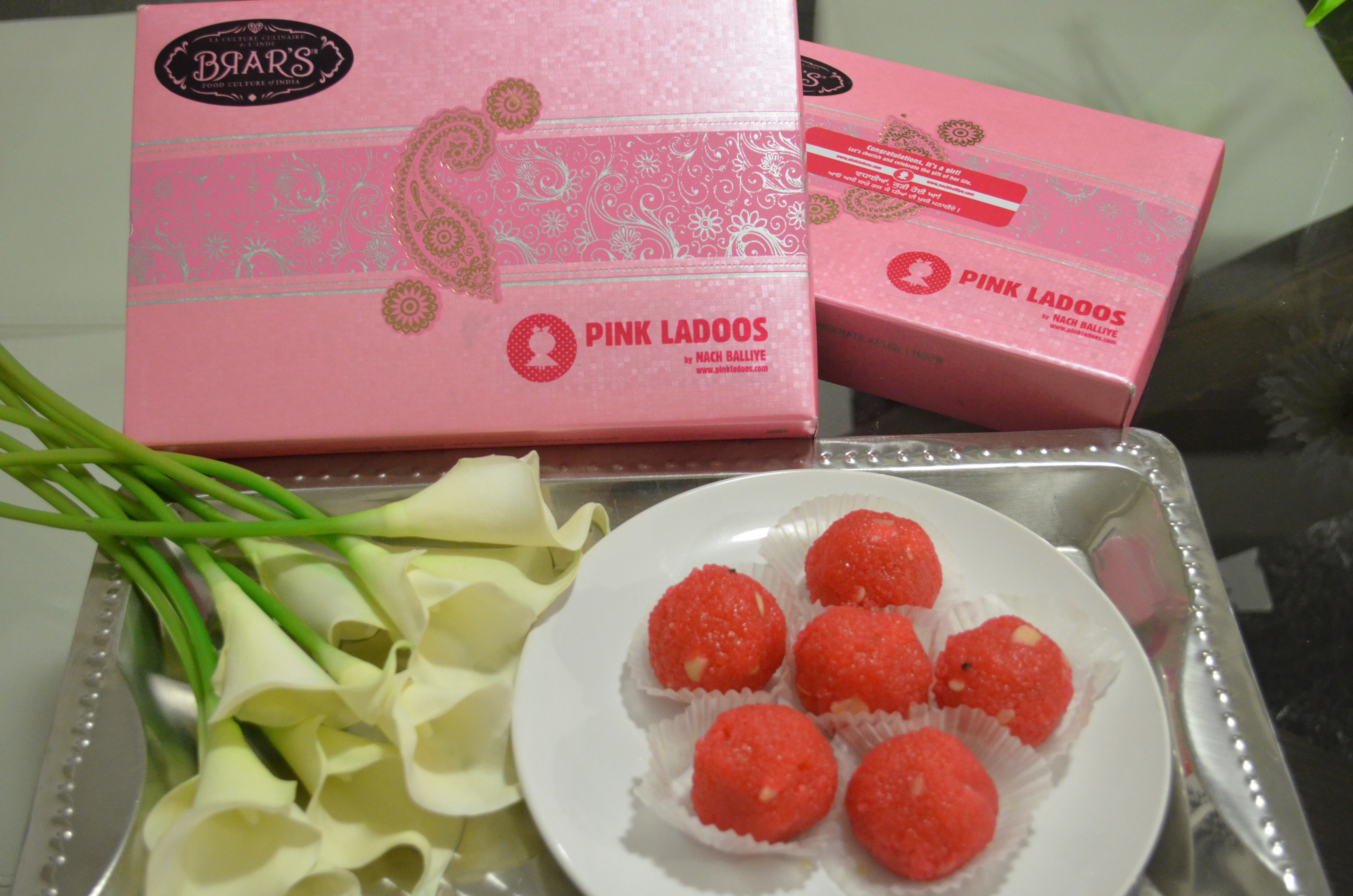
Recently, Brar's Food Culture of India, helped Nach Balliye, a youth group from Brampton to educate and promote gender equality, by donating 100 lbs. of pink ladoos. This Diwali, the company has made/produced some 175,000 pounds of food to meet the consumers' demand for Diwali. Photo courtesy, Nach Balliye.

Recently, Brar’s Food Culture of India, helped Nach Balliye, a youth group from Brampton to educate and promote gender equality, by donating 100 lbs. of pink ladoos. This Diwali, the company has made/produced some 175,000 pounds of food to meet the demand for Diwali.
Photo courtesy, Nach Balliye.

Here’s wishing you all a very Happy Diwali. Much like Dial, let’s all find and pursue our passion, and have fun making the magic happen.

When art meets life, so much of it is lost in translation

Standard
Dr. Balvinder Singh, an pediatrician from India has come to the realization that in real life, unlike the reel one, courage and strength of character are the real currency for an immigrant. Photo by Bryon Johnson

Dr. Balvinder Singh, a pediatrician from India, now settled in Canada, has come to the realization that in real life, unlike the reel one, courage and strength of character are the real currency for an immigrant.
Photo by Bryon Johnson

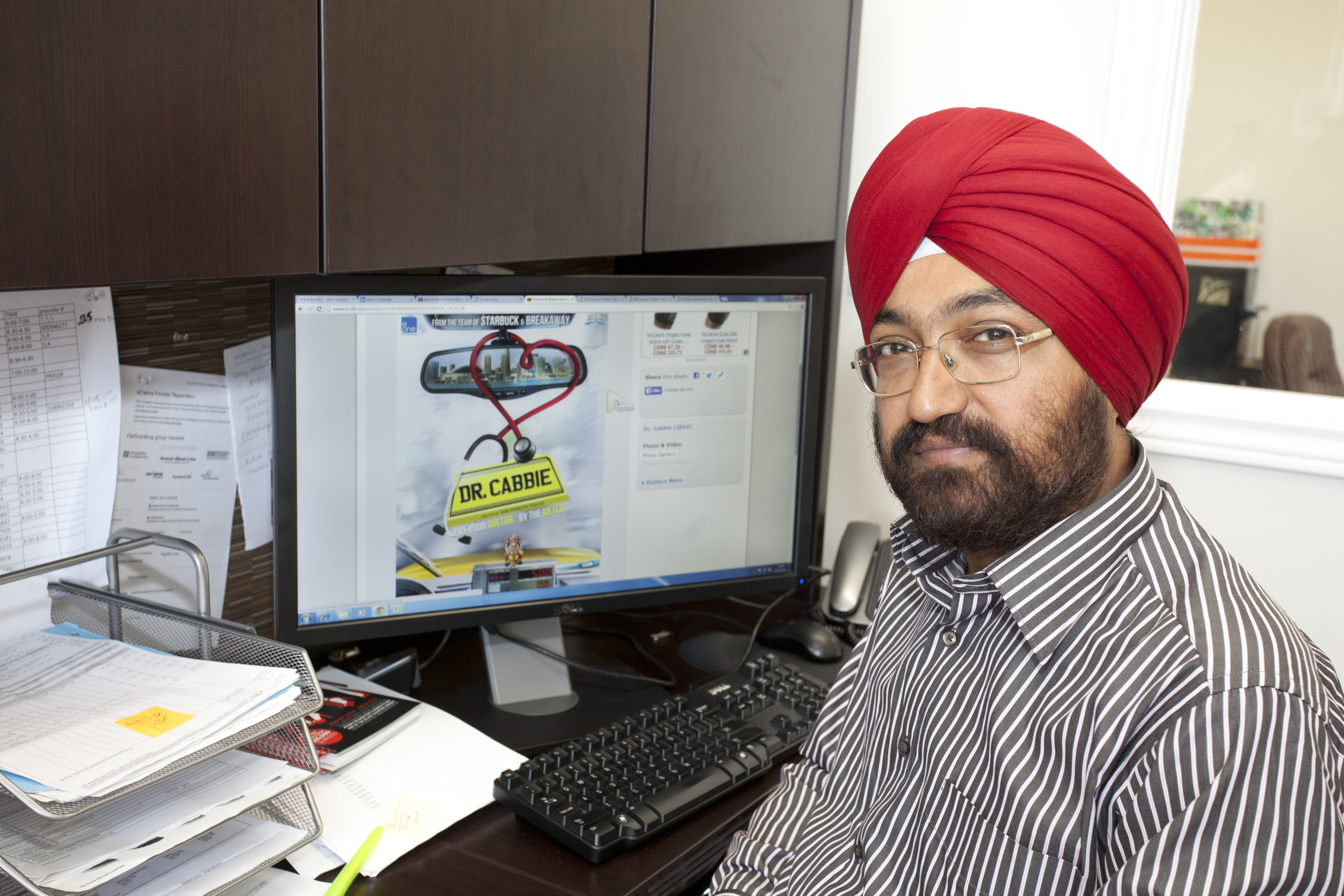
Meet Toronto’s the Dr. Cabbie.

Three years ago, an Indian pediatrician and newly arrived immigrant to Canada found himself thrust in the glare of media.

Unlike a Bollywood film where his heroism would have seen him riding happily into the sunset, reality was something of a bitter medicine.

Here’s what happened: Dr. Balvinder Singh, 42, was on a Delhi –Toronto Air India flight when a woman went into labour. The Punjab native used scotch to sterilize the scissors. A sewing kit went towards clamping the umbilical chord of the newborn and the microwave was put to use to heat the blanket to swaddle the baby.

Akash Leen Kaur weighed seven pounds and made a somewhat dramatic entry into the world, some 11,000 metres above the skies of Kazakhstan.

In the days that followed, as reports of Balvinder’s deed spread, media from every corner of the world clamoured to interview him. Interestingly, he gave phone interviews to the press while plying his route as a trucker. The media had a field-of-a-day reporting the paradox of a fully qualified and experienced doctor driving an 18-wheeler in Canada.

Balvinder soon became the poster child for “Canada’s broken immigration policy,” except as with everything, this story too has many layers.

So, recently when the buzz around Dr. Cabbie intensified. I sought Balvinder out to see how his life had panned out since his 15-minutes of fame.

For those unaware, Dr. Cabbie’s plot revolves around how an Indian doctor turns his taxi into a mobile clinic when faced with rejection by the Canadian accreditation system. In the celluloid version, everything works out well for the hero. Our real life Dr. Cabbie has an entirely different story to report.

Few months into his new life in Canada, Balvinder became resigned to the fact that his life as a physician was over. So, he enrolled in a trucking course and cleared it with flying colours.

Most people would have been bitter about having to drive a truck when they ideally should be handling a stethoscope. But not Balvinder.

He told me he was fully aware when filing his papers that he would face an uphill battle finding a job as a physician. Like most newcomers, he immigrated to the country to provide better opportunities for his children.

A few weeks into his trucking job, Balvinder quit. Disheartened, but not discouraged, he applied for jobs in the clinical research area and worked briefly in the field, but his contract was not renewed because of lack of funding. So once again he found himself at the crossroads.

“I was a misfit as a trucker,” he said. “I was physically not fit for it and the hours were difficult for my family as my wife was working two jobs and there was no one to take care of my children. Last year, I applied for 70 jobs, but I did not get a single interview. Since my priority has always been my family, I don’t regret or feel disappointed about working as a security guard or a trucker.”

He then trained to become a security guard.

“The worst thing in life is staying at home doing nothing. I couldn’t do that,” he told Toronto Desi Diaries.

He was briefly dejected when he did not receive a single response from prospective employers, but he did not give up. He continued to work as a security guard. Then six months ago, he and a friend started a foot-clinic. He still continues to work as a security personnel, occasionally.

Big Bang Theory actor Kunal Nayyar arrives in a cab at the music launch of his first film, Dr. Cabbie. Photo by Claudio Cugiliari.

Big Bang Theory actor Kunal Nayyar arrives in a cab at the music launch of his first film, Dr. Cabbie.
Photo by Claudio Cugiliari.

Balvinder has been knocked-down several times in life, but he retains his sense of humour and positive attitude. He’s an inspiration.

“I have enjoyed fame, success and money,” he said. “All I can tell you is that it’s lonely at the top…”

Getting accredited as a physician in Canada can be frustrating because even though most foreign-trained professionals clear the exams, they are up against the wall when it comes to finding residency. There aren’t enough spots and the ones that are available are offered to Canadian students who undergo their MD training abroad. According to a new study, only half of international medical graduates in Canada are currently working as doctors. The rest are languishing in survival jobs.

In the study conducted at St. Michael’s Hospital in Toronto, researchers found in 2011, 1,800 applicants competed for 191 residency spots designated for foreign-trained physicians in Ontario, but only 55 per cent of these graduates ended up working as physicians.

Balvinder admitted to being curious about Dr. Cabbie and vowed to check it out.

“When you see it (film) from the perspective of past, it’s easy to chuckle,” he said, “But while you are going through it, you will literally feel the pain. I will still say, challenges are part of life and I can’t blame Canada for my life because we opted for the greener pastures… Canada is a land of opportunities, but you need time to cash in on those opportunities.”


Kunal Nayyar’s warm personality makes Dr. Cabbie a must-see

Standard
Dr. Cabbie is a Canadian film featuring Kunal Nayyar, Isabelle Kaif and Vinay Virmani, set to release, Friday, Sept. 19.

Dr. Cabbie is a Canadian film featuring Kunal Nayyar, Isabelle Kaif and Vinay Virmani, set to release, Friday, Sept. 19.

My day job allows me to meet and chat with politicians, musicians, artists, newsmakers and on rare occasions, an odd criminal or two.
I have had my share of interactions with jerks that lug around a sense of entitlement like dandruff on black shirts, to ego-less entities with absolutely no trace of arrogance.
Kunal Nayyar, 33, definitely falls into the latter category.
Some weeks ago, when I sat down with the rising stars of Dr. Cabbie, a Canadian movie with liberal dose of Bollywood, I was naturally excited to snag one: one interviews with the movie’s three actors — Kunal, Isabelle Kaif and Vinay Virmani.
As an avid fan of Big Bang Theory, I wanted to meet Kunal, aka Rajesh Kootrapalli, so I could tell him his portrayal as a socially awkward nerd in the CBS sitcom elevates the show’s comedy metre to lofty levels each week. The meeting/interview also gave me exclusive bragging rights in the newsroom where every single reporter/editor and photographer is a die-hard fan of Kunal and BBT.
Kunal enjoys mega celebrity status here and elsewhere. Canadians love him and his show. Who hasn’t chuckled at Raj’s antics, especially the hilarious side effects of his selective mutism, an anxiety disorder, because of which his character can’t talk to women unless he’s all liquored up.

So, coming back to the media launch of Dr.Cabbie, I reached the downtown hotel 35 minutes before the appointed hour, but there may have been few no-shows from some news outlets, so my interview was moved up. Before I could collect my wits or gather my notes, I was facing Kunal who despite his exhausting schedule, greeted me with a real smile (the kind that reaches the eye) and introduced himself.
He was the real deal. He answered questions I threw at him with sincerity and self-deprecating humour. A few moments into the talk, It became pretty evident that Kunal doesn’t lug “star” baggage. He had no airs.
Here’s the interview Toronto Desi Diaries (TDD) had with the Big Bang Theory star. Kunal spoke about his role in Dr. Cabbie and briefly, just so briefly, touched upon Canada’s immigration system. So, I suggest y’all brew a cuppa, sit back and read on.

TDD: Did you say “yes” to Dr. Cabbie because your character was the opposite of Raj in Big Bang Theory?
KN: I love playing Raj on Big Bang, It’s a dream come true for me to be on the show. So, when I had time off in the summer and I was looking at movies, the script (Dr. Cabbie) came up on my agent’s desk. One of the things I have been telling everybody is: I want to play a character that’s different from Raj because I am a trained actor and I thought it would be fun to spread my wings and show the world I have many different facets.
So, it was fun to play a cab driver whose centre of gravity is way down. Someone who heckles women and shows-off his chest hair, drinks, eats and lives life with reckless abandon.

From L to R: Isabelle Kaif, Kunal Nayyar and Vinay Virmani, as they arrive for the music launch of Dr. Cabbie in a yellow and red cab. Photo by Radhika Panjwani

From L to R: Isabelle Kaif, Kunal Nayyar and Vinay Virmani, arrive for the music launch of Dr. Cabbie in a yellow and red cab.
Photo by Radhika Panjwani

TDD: Was it a challenge…?
KN: Every summer, when we get to the first table read (for Big Bang), I always worry I have forgotten how to act. I think every actor goes through that. You are sitting there wondering, “Hope, I haven’t forgotten to be funny.”
The truth is: The writing is so good that as soon as you begin to say the words, it flows into you. The writing — for eight seasons of Big Bang has been consistent — and that’s so rare.
TDD: How was your experience in Dr. Cabbie different from that of the Big Bang Theory in terms of the set?
KN: For Big Bang, we shoot in front of a live studio audience in the Warner Brothers Studio. All the sets are built on the stage. With Dr. Cabbie, we shot a lot of stuff all over Toronto. So, it was fun because we would be driving along the streets in this cab with a camera on us shooting a scene and people would wave at us. In Big Bang, you were in a closed environment whereas in Dr. Cabbie we were exposed to the elements and the cities of Toronto, Mississauga and Brampton.
TDD: The film showcases the immigrant experience, were you able to identify with the struggles of the characters?
KN: I have lived the immigrant story. I moved to the U.S. when I was 18.
Will the movie deter people from filing their papers to Canada? I am not sure. I hope what people actually take away from this movie is: things don’t always go according to plan in life. They don’t. Life takes a U turn. There’s no blueprint or secret formula. Stuff happens and ultimately, it’s about how you pick-up and move on. One has to live life with a big heart and be willing to do anything to realize their dreams…

TDD: How’s your family reacting to your venture into films?
KN: My family is very proud. It’s very easy to become complacent in this industry. I never want to be a victim of that. I want to work as hard as I can and do as much as I can.

Next up: Toronto Desi Diaries’ up, close and personal meetings with the other two cast members of Dr. Cabbie —Isabelle Kaif and Vinay Virmani and my chat with a real-life Dr. Cabbie/trucker – Dr. Balvinder Singh.

Rajdeep Chatterjee: all set to wow the Canadians

Standard
Bollywood singing sensation Rajdeep Chatterjee will perform at the Bollywood Monster Mashup (BMM) at Celebration Square in Mississauga, Saturday, Aug. 30.

Bollywood singing sensation Rajdeep Chatterjee will perform at the Bollywood Monster Mashup (BMM) at Celebration Square in Mississauga, Saturday, Aug. 30.

Vikas Kohli, artistic director, Zee Bollywood Monster Mashup (BMM), straddles two musical worlds— western and masala Bollywood — with ease.

The internationally renowned music producer/composer and his state-of-the-art studio, Fatlabs are pretty well known in this part of the world, but apart from his  musical IQ, Vikas has weighty academic credentials as well.

Let’s see, honours degree in math and philosophy as well as business and CFA (chartered financial analyst) degrees. Trust me, in journalistic circles, an intelligent, well-read and successful source can become a coveted and valued asset. It’s he or she that sets the tone of the story.

I digress. When the press release about Vikas’ Bollywood Monster Mashup (BMM) landed on my inbox, I asked my colleague if I could ‘poach’ on his beat. That’s how much I wanted to write about it.

Unlike most other festivals that cater to desis, BMM attempts to bridge two cultures — Canadian and Indian —with its fantastic fusion offerings. The main stage event on Saturday, Aug. 30 has Vikas’ stamp all over it. One segment will include Indian artists and singers crooning alongside western musicians and mixing melodies to create a heady cocktail of notes.

Rest assured, the show will run as per schedule because Ottawa-born Vikas has zero tolerance for the tardy Indian Standard Time (IST).

Last year, Vikas received a frantic call during the show from his event manager saying they were running three minutes behind, but with some minor tweaking, the concert was set back on track. Most organizers would have dismissed those three minutes as a minor irritant, but not the good folks at BMM. Now, that’s something everyone will appreciate, especially the fans.

******************

Bollywood singer Rajdeep Chatterjee will headline the free concert at Celebration Square in Mississauga. Here’s an exclusive chat Toronto Desi Diaries had with the immensely talented artist.

TDD: Tell us about some of the highlights of your life prior to your fame?

Bollywood Singer Rajdeep Chatterjee will headline the free Bollywood Monster Mashup concert, Saturday, Aug. 30 at Celebration Square Mississauga.

Bollywood Singer Rajdeep Chatterjee will headline the free Bollywood Monster Mashup concert, Saturday, Aug. 30 at Celebration Square Mississauga.

RC: I started learning music from the age of three. My mum was my first guru. I learnt Hindustani classical music for a few years and then started performing live at the age of eight. It has been 15 years now and I have done around 1,500 shows across the world. Before being the 3rd runner up of Indian idol season 4, I was also a part of Zee Lil champs in ‘05-06 where I reached the final 11, but had to quit because of my exams.

TDD: What about your struggles?

RC: Yes, struggle is a part of almost every artist’s journey and it’s not just the physical struggle, but the mental one as well. I was quite an introvert before I actually started performing live. In school, I was somehow not considered a good artist and was never given a chance to perform when all the other singers were given opportunities to prove themselves. But the will was always there. I waited and waited and finally got the television reality shows. That’s when I realized I could entertain people.

TDD: What are your strengths aside from the great voice and a great smile?

RC: Well, I believe my strength is my ability to spread happiness and positive vibes through my music and performances. I really work hard on stage to give everything I can … I have seen people connect to my music when I do it live. I am a very positive soul and I guess, I find it easy to spread smiles and happiness. If your art touches people’s hearts, you’re worth it.

TDD: What are you looking forward to at Bollywood Monster Mashup?

RC: I am extremely excited to be a part of BMM; it is one of the best Bollywood festivals internationally. The audience at BMM is always amazing and it feels like homecoming whenever I come to Canada.

TDD: How did you meet Vikas (Kohli) and why did you agree to perform at BMM?

RC: Vikas is like a buddy, a brother to me. We call each other as bhai. We have known each other for two years. I absolutely love his family, his mum and his cousins. I am always game for everything that Vikas bhai does.

TDD: Playback singing is a competitive environment, are you ready to take it on?

RC: Only true talent gets to shine among so many singers who are trying to make it big in the industry. I have been lucky that my hardwork has paid off and I have been singing for big Bollywood movies. I hope to continue doing that for years to come.

TDD: Your song for Bodyguard was a hit, when did it strike you that you had made it?

RC: It was a great experience to sing the title track of Bodyguard, Khiladi 786, and I also got to sing for the Bengali version of Gunday. I was also a part of Coke Studio season 2 for music director Shantanu Moitra. Recently, I started my own unplugged YouTube channel (IMX unplugged) where we do a lot of melody stuff. We are getting a great response.

TDD: Some quick questions

Favorite all-time movie: I am a hardcore SRK fan, so DDLJ (dil wale dulhaniya le jayenge).

Favorite cuisine: I love Indian food all the way

Philosophy that you stick by: love yourself. Only you know how to do it the best way

Success is: When I have “N” number of reasons to smile and be happy

If not a singer, what then: I would have had to discover an art that no one had ever tried and entertain people because I have always wanted to be a performer (laughs)

The Monster Mashup Double Take will run Saturday, Aug. 30 at Celebration Square Mississauga. Main stage portion will start at 6 p.m. Be sure to catch it.


Pineapple !

Standard

This is the second of our two-part blog series on Prashant Tiwari. RIP, kiddo.

20-year-old Prashant Tiwari was an aspiring hip-hop singer who suffered from depression. He killed himself while on suicide watch at a local hospital. His friends said his life will remain an inspiration for them. Supplied photo.

20-year-old Prashant Tiwari was an aspiring hip-hop singer who suffered from depression. He killed himself while on suicide watch at a local hospital. His friends say he will live in their hearts, always. Supplied photo.

If you were among the people that attended Prashant’s funeral, you probably witnessed an odd ritual.

Moments before his body was taken for cremation, the silent hall was punctuated with cries of “pineapple!”

The prickly tropical fruit, it so happens, was a buzzword for four young struggling musicians who wanted to communicate with the world and bring change through their lyrics and music.

Mayank Paul, 19, a member of Definition, a hip-hop group that Prashant belonged to, explained the chant.

A few years ago, Mayank Paul (MP), Shehzeb Iftakhar (Devious), Sukhman Dulay (Dulay) and Prashant Tiwari (PT), all members of Definition, were shooting the breeze and brainstorming about taking the world by storm, when PT, the ever pragmatic one among them, pointed out the obvious: their music was way too complex for the average human.

“He (Prashant) said we need to take all our lyrics and dumb them down,” Mayank recalled. “So, we were like, how do you dumb stuff down?”

“We need to say smart stuff stupidly,” Prashant quipped. “Yo, say anything on track, say, pineapple…”

And so “pineapple” became the mantra they used often when trying to connect with the quirky world that— at times — didn’t get them.

On a recent summer day, ten days after he was admitted to the local hospital, Prashant, hanged himself. He was under suicide watch. But, while he was in the hospital, his friends and family visited him daily.

“He couldn’t accept a lot of things and so, he wanted to change a lot of things,” Mayank said. “In one of the last conversations we had with him, he told us, we shouldn’t blame ourselves for the situation he had put himself in.”

During his short and troubled stint on this earth, all Prashant Tiwari ever wanted was, the world to validate his existence.

Definition members met by happenstance while in high school and connected. They all had one thing in common: an itch to transform the world, one hip-hop song at a time.

The quartet believed there was a growing feeling of alienation among teens today. School administrators couldn’t care less. Worse, no one in their immediate world, had the inclination or time to listen, coach or guide them.

Prashant was funny and wise. He was a jester and a philosopher. He understood the black and white shades of life, but could not handle the gray areas.

Not a day goes by when Gautam Tiwari, 17, (Prashant’s kid brother) doesn’t miss him.

“Depression doesn’t happen suddenly,” Gautam said. “It builds up. When kids leave high school, we are completely left in the dark. There’s a huge pressure to go to university. We have counsellors in school, I am not sure, if they are trained in mental health, they should be. Prashant was a driven person, but depression eats away at you slowly.”

School wasn’t Prashant’s thing. He wanted to be a rapper. Music was his salvation; his antidote to keeping the monster that was depression at bay.

“We were all pretty serious about making music that would make an impact,” Mayank said. “One of the things people should know about Prashant was that he wanted to discipline himself to the point nothing would faze him. He focused on his body and mind. Do you know any 19-year-olds interested in taking Sanskrit classes? Prashant wanted to learn the vedas and use them as references to guide his mind, body and spirit…”

“He always stood-up for what was right,” he continued. “Prashant had no problem saying anything that was in his mind. He was a very funny guy. He always did spontaneous things…”

There’s a huge expectation in our society to succeed, but what’s success? And who defines it?

Definition will be releasing an album soon that will include a track called No More that Prashant recorded a long time ago.

Prashant, you said it right. Ultimately, all existence comes down to the pineapple philosophy.


Spitty’s fiery poetry has undertones of some serious stuff

Standard


Toronto Hip Hop musician Spitty is making quiet waves for his music. The rapper tackles social issues such as mental health, addiction and teenage pregnancy in his work. Supplied photo

Toronto Hip Hop musician Spitty is making quiet waves for his music. The rapper tackles social issues such as mental health, addiction and teenage pregnancy in his music.
Supplied photo

Most Hip Hop musicians wear a “bad boy/bad girl” vibe like an accessory.

So, when a shy and polite Lankesh Patel agreed to share his passion for that genre of music, he was a far cry from the in-your-face musician, I imagined he would be.

When I say “Lankesh Patel” what does the name evoke? It probably elicits an image of a good-looking Gujju lad probably studying a STEM ( science, technology, engineering and mathematics) program, juggling long-hours at a summer job to pay for his tuition and importantly, a dutiful son on his way to fulfilling the modest dreams of his immigrant parents.

Dead on.

Now, I urge you to scratch the surface. Spitty, an immensely talented, hip-hop artist with a natural flair for music, will emerge. Spitty sports a beard, wears a ball cap, black tee and nondescript jeans, mercifully not a sagger. The silver chain around his neck could pass off as bling, but even that is not an overt symbol.

Then as you listen to his music, Lankesh quietly and completely disappears. The torrent of words— stringed in a rhythmic beat— escape Spitty lips like gallons of water gushing out of a pipeline. This kid was definitely born to rap.

“Whenever I meet people and have to tell them who I am, I don’t tell them I am a computer science student, I tell them I am a rapper,” he said. “I don’t enjoy anything else as much as I do rapping. That’s who I am.”

It was during elementary school that Lankesh found his inner rapper. He recalled how he would have a spring in his step when walking to the bus stop because he rapped the entire distance.

“Poetry and rap are very similar, yet different,” he said. “Whenever we had to do artistic writing in school, I got good grades, so I figured if I could write, I could probably make it into a song.”

Unlike the profanity-laced verses of well-known names populating this genre, Lankesh’s lyrics are PG, but that doesn’t mean he doesn’t push the envelope.

Take for instance his latest video— Life— shot in fabulous Toronto where he talks about prostitution, pregnancy and what not.

Everybody’s out here struggling, we all grew up in our own way, cause life ain’t never nothing fair…

“In (Life) I tried to write lyrics to depict the sadder aspects of life, but at the same time create a song and video that enforce positivity and appreciation,” he says. “I just hope this video/song helps people take a minute to appreciate what they have and maybe think about how they can help out others.”

Spitty has won prizes for tackling serious issues such as mental health and addiction. Speaking of which, Lankesh’s rap video of Toronto Mayor Rob Ford dubbed Tom Ford went viral.

Similarly, in his song, Brampton, he pays ode to his hometown B-town. After the song and Lankesh’s story were featured in the local newspaper (the one I work for), city officials invited him to be part of Canada Day celebrations. In the video, Spitty pays homage to all famous Bramptonians and they include: NBA stars Tristan Thompson and Anthony Bennett; stand-up comedy king Russell Peters, super-funny and Superbad Michael Cera and others.

When I pointed out to the absence of heavy-metal bling on his body, Lankesh-the-good-kid shyly smiled. I figured, neither the bling—or the sagger— would have gone well with his parents, particularly his grandmother, who driven by absolute love for her grandson can be coaxed into listening a rap song or two, but strictly Spitfire music only.

“To this day, I have never sworn in a song,” Lankesh said. “I have never talked about sex or violence, although I talk about stopping violence. My music is about who I am and since I am not in a gang and I don’t do drugs, I don’t talk about those things…”

“When I first started, I didn’t even know what to tell my parents, so I didn’t tell them anything,” he said. “Eventually, we had contests in schools and I always entered these. I used rap to make the videos creative. When I started winning the contests, my parents were okay with it. Though, I don’t know if they know what I am saying in my videos…”