Move over butter chicken, the Kerala chicken curry is here

Standard
Kerala, a coastal state in India, boasts of cuisine that's full of flavours. The Kerala chicken curry is especially a universal favourite

Kerala, a coastal state in India, boasts of cuisine that’s full of flavours. The Kerala chicken curry is especially a universal favourite.

In the earlier posts, I attempted to capture some sights and stories of South Asians in Toronto.

Well, it’s time to direct the rickshaw towards some culinary delights. A highlight Toronto’s multicultural identity is that the city offers its patrons a whole variety of ethnic food to choose from. Some are wildly popular, others remains hidden gems. If I asked you to cough up the names of some Indian dishes, you are more than likely to answer: butter chicken, naan, chicken tikka or palak paneer.

Since the Canadian palate appears to have fallen in love with the mild flavours of the ubiquitous butter chicken and its perfect dance partner, naan, most restaurateurs are wary of introducing anything else on their menu. If it works, why fix it, right?

Here’s the thing; Indian cuisine, much like the country itself is vast and varied. Each region has its own distinct culinary style.  Many of the dishes will tantalize the taste buds and send you to food nirvana.

Yes, it’s great, butter chicken and the samosas have nudged their way right into the mainstream fare, but these are not the prototypes of India’s mind-boggling gastronomy. Allow me to introduce you to some less-known, nevertheless great mouthwatering dishes.

Nestling amidst swaying coconut trees and lush greenery, is Kerala. A coastal region in the Southern region of India characterized by groves of mango, jackfruit and coconut trees, punctuated with rubber, coffee and tea plantations, cashew nut trees and orchards redolent with spices such as cardamom, cinnamon and pepper.

Often referred to as God’s Own Country, Kerala definitely lives up to its moniker. What’s unique about Kerala’s cuisine is that unlike the calorie-laden richness of butter chicken, food hailing from this region is light (as it’s steamed or cooked with minimal oil). The dishes sport rich flavours tempered usually by a paste of coconut, ginger, green jalapeno, black pepper, nutmeg, cardamom and other spices.

Fish, fowl and vegetables are an integral part of Kerala’s cuisine. At the time of festivals, weddings and other occasions, food is served and eaten on a banana leaf.

Here’s a recipe for Kerala chicken. You can substitute the fresh powdered spices with (Eastern brand Chicken masala) readily available in any Kerala store in the GTA.
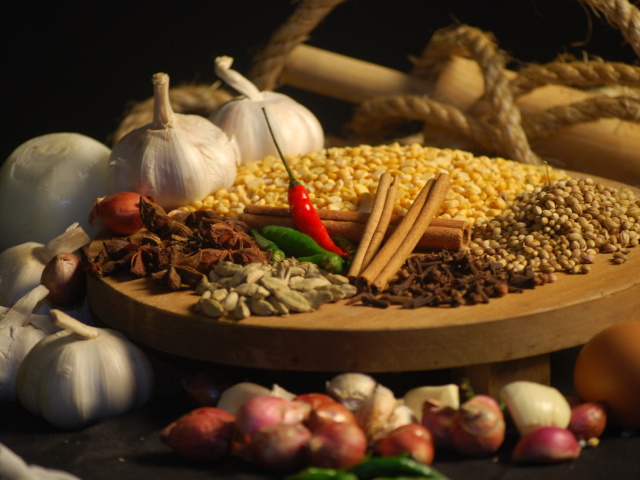
Kerala cuisine is redolent with spices such as cardamom, peppercorn and coconut. Image courtesy Zastavki.com

Kerala cuisine is redolent with spices such as cardamom, peppercorn and coconut.
Image courtesy Zastavki.com

KERALA CHICKEN CURRY

Serves six

You will need:

Chicken – 2 lbs. bite-sized pieces

Onions – 1 large chopped

Tomatoes – two large diced

Ginger/ garlic paste – 1½ teaspoon

Oil (Canola/vegetable) – 3 tablespoon

Coconut (grated) – 1/3 cup

Red chilly powder— 1 teaspoon

Fennell seeds — ½ teaspoon

Cumin seeds — ½ teaspoon

Peppercorn— ½ teaspoon

Cloves — 4 nos.

Cinnamon— 1-inch stick

Cardamom — 3 nos.

Lemon juice — one lime/lemon

Yoghurt— 3 tablespoons

Prep work:

Marinate chicken pieces in lemon juice, yoghurt and salt. Refrigerate for a couple of hours

Dry roast on low flame and powder: Fennel seed, cumin, cloves, peppercorn, cardamom and cinnamon
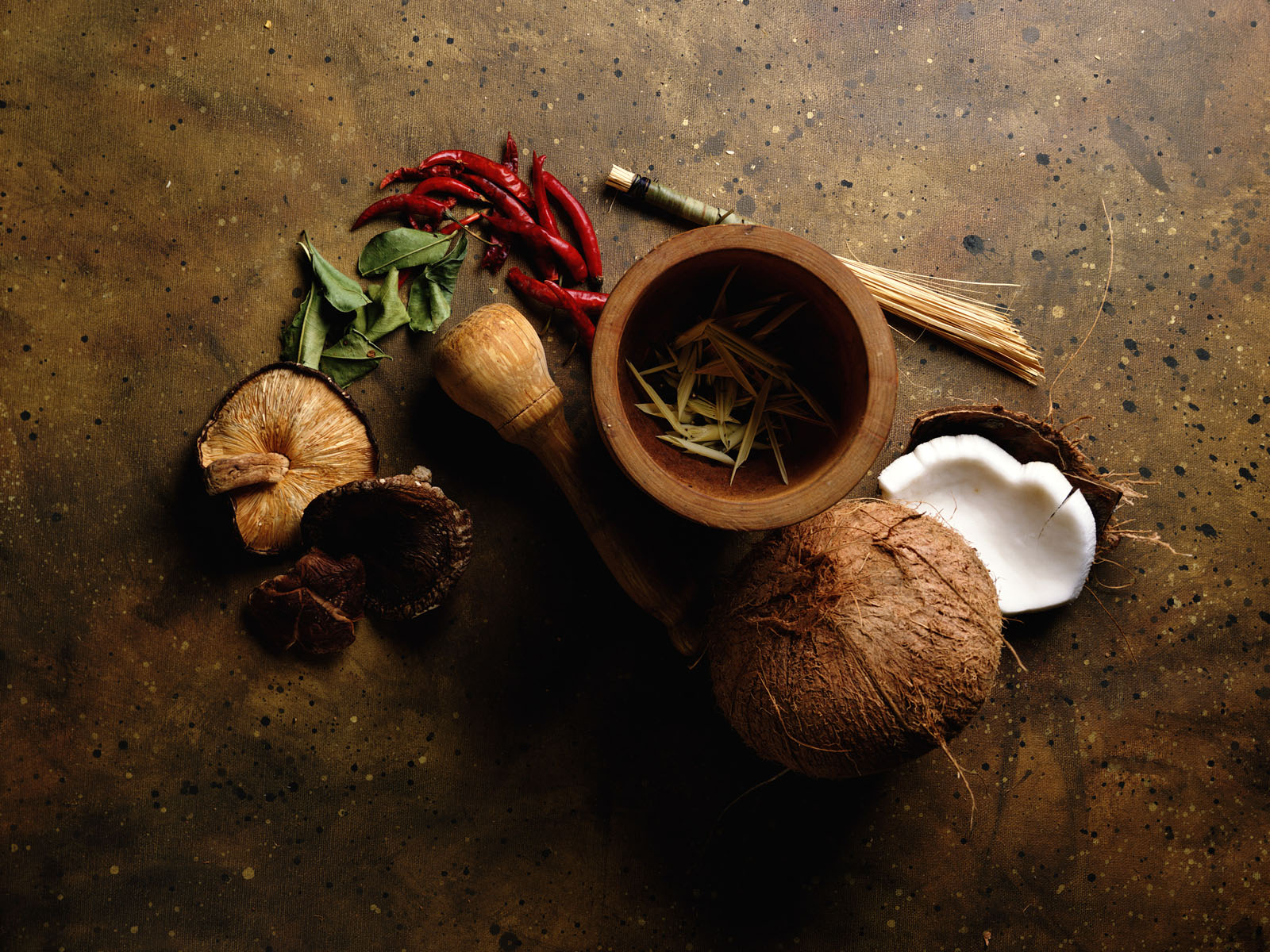
Kerala's cuisine boasts of staples such as coconut and fresh aromatic spices such as peppercorn, cardamom and cinnamon.

Kerala’s cuisine boasts of staples such as coconut and fresh aromatic spices such as peppercorn, cardamom and cinnamon.

Instructions
1. Heat oil in a non-stick or heavy-bottomed pan. Toss and saute the onions.

2. Add ginger, and garlic paste. Cook until onions turn golden brown.

3. Add diced tomatoes till it softens and has a sauce-like consistency. Add salt, red chilly powder and Eastern chicken masala. Turn the heat to minimum.

3. Toss in coconut (grated either fresh or frozen) and about 1 ½ tablespoon of powdered spice mix. Add very little water and make a paste.

4. Add coconut and spice paste to the simmering sauce. Saute for 2 to 3 minutes. Add half-a-cup water.

5. Now add in the chicken pieces. Cover and cook in medium-low heat for 20 minutes. Check to ensure chicken is fully cooked. Sprinkle remaining dry spice mix. Cover and let the flavours sit.

Enjoy it with steamed white rice or tortillas

Don’t dare him, he may take you up on it

Standard
Suresh Joachim, Canada's #1 record holder will be undertaking a World Peace Marathon in 2017. Illustration courtesy Sureshjoachim.com

Suresh Joachim, Canada’s #1 record holder will be undertaking a World Peace Marathon in 2017.
Illustration courtesy Sureshjoachim.com

As a rookie reporter, I groaned whenever I heard/read about Suresh Joachim (pronounced Joe-Kim) attempting a stunt for the Guinness World Records (GWR).

The unstoppable thrill-seeker successfully pulled off every imaginable dare. As a result, I ended up writing at least one story every other week on the Mississauga man. For a while, my colleagues joked I had made it as a beat reporter after being on the job for less than six months.

That was some years ago.

Now at 43, Joachim has shattered 68 world records in the last 15 years. Alas, he does not hold the world record for most records. That honour belongs to Queens, N.Y. native Ashrita Furman, 56.

Joachim, an accountant by profession, however remains unperturbed because as he points out, Furman has been at it for 40 years, whereas he himself has  only started.

So far, the Sri Lankan-Canadian, holds records for among other things: the most distance moon walked in 24 hours (49.252 km), ironing continuously (55 hours, five minutes), most time spent watching television (69 hours and 48 minutes), longest dance marathon, longest drumming marathon and his very first record —running 3,495 kms every hour for 42 days.

Some of his records are quirky, others require endurance and training, but in the end, he manages to accomplish both with characteristic modesty and same single-mindedness.

Suresh Joachim is Canada's #1 record holder. He has broken 68 world records.

Suresh Joachim is Canada’s #1 record holder. He has broken 68 world records.

“I have experienced a lot of pain in my life and that’s what drives me,” said Canada’s # 1 record holder. “I get the power and strength to do the things I do because of my faith in God. I feel this is my purpose and this is what I was born to do. I am only taking the steps he (God) wants me to take.”

Celestial intervention or not, there’s one record he vows he will never repeat again.

“I balanced on one foot 76 hours and 40 minutes,” he said. “It was very painful. If someone offered me $10 million to do it, I still won’t do it.”

Growing up in Jaffna, Sri Lanka, during a tumultuous time in the country’s history, the father of two, watched and experienced the ethnic strife between the Tamils and the Sinhalese communities escalate to the point when violence was part of people’s daily lives. Peace was something elusive and precious.

The staid bookkeeper said he decided to become a serial thrill-seeker on his 21st birthday after an uncle gifted him the shiny silver Guinness World Records book.  Joachim recalls experiencing a sense of awe when he cradled the mammoth book. Excited and wide-eyed, he devoured the contents greedily. It was as if the book was a gateway to a world of possibilities.  And thus began his sojourn.

Joachim plans to embark on his most ambitious project yet. Slated to begin on Christmas Day in Bethlehem in 2017, the World Peace Marathon will wrap-up in Toronto a year or two later. As part of the project, Joachim will carry the peace torch and run across 76 countries and 120 cities to raise $1 billion.  Along the way, he will also get some 500 million people to sign a petition for one day to be declared World Cease Fire Day, he says.

Like me, I bet you are wondering where does he find the money to do all this? The answer is simple. Joachim finances his all endeavours through sponsorships.

Which record did he have most fun? He says all were equally thrilling, but his record for the fastest feature-length film ever made (11 days, 23 hours and 45 minutes) remains close to his heart. The movie Sivappu Mazhai (Red Rain) was shot in India in 2009.


This app creator for Apple is a 10-year-old wunderkid

Standard
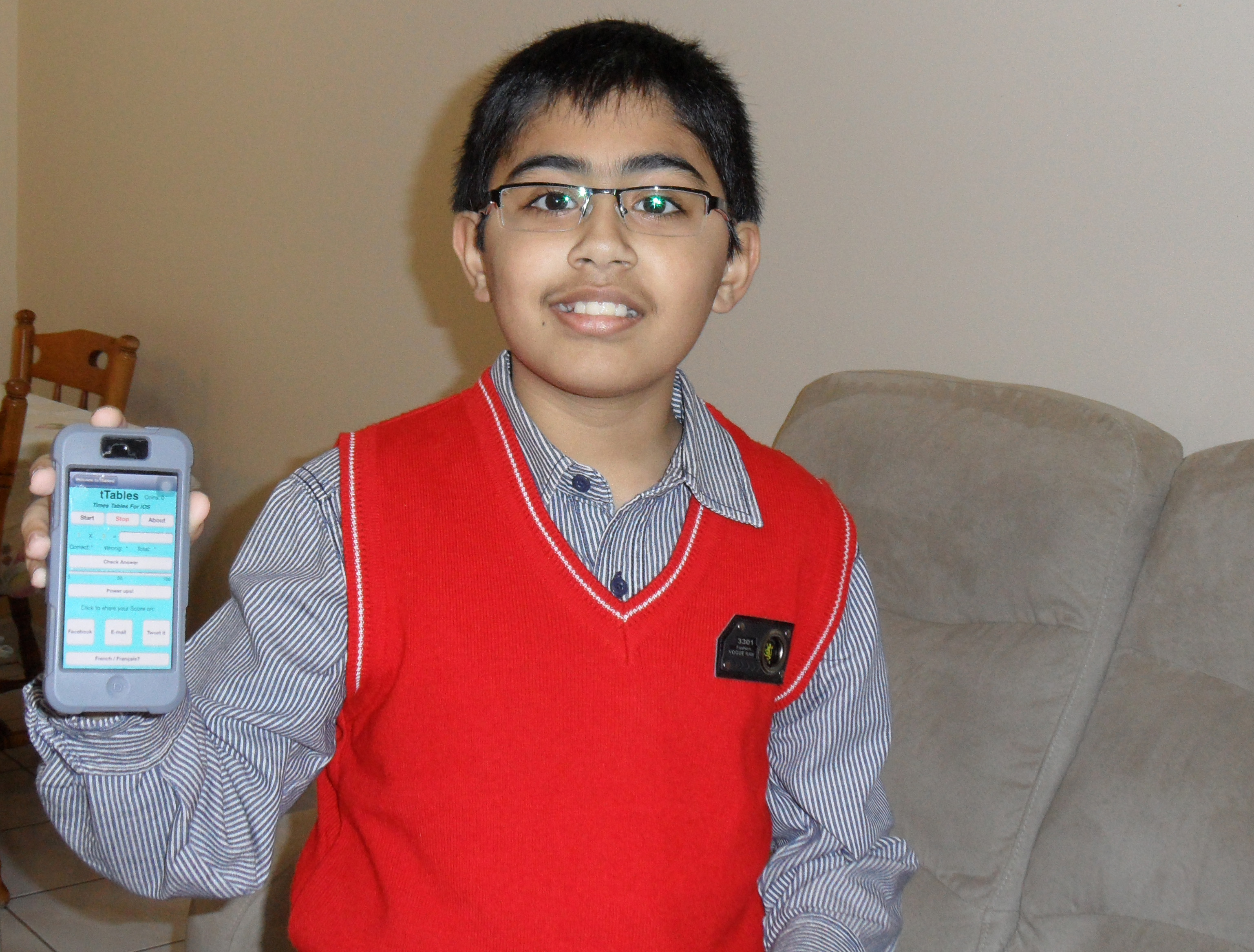
Tanmay Bakshi, 10, has successfully developed an app for Apple. His aptitude for computing and coding has made him a celebrity in Canada and abroad. Photo by Radhika Panjwani

Tanmay Bakshi, 10, has successfully developed an app for Apple. His aptitude for computing and coding has made him a celebrity in Canada and abroad.
Photo by Radhika Panjwani

I am not usually intimidated when interviewing ten year olds, but while chatting with a pint-sized  prodigy whose app was accepted by Apple recently, I was momentarily speechless.

The reason probably had more to do with the fact the kid was clearly a genius, whereas, I have had a long-standing feud with numbers, integers and what have you.

Dressed in gray buttoned-down shirt and red sweater vest, a bespectacled Tanmay Bakshi, looked like any other elementary school student, until he started to speak. Not only could he hold on his own, his passion and love for coding lit up his entire face.

Tanmay’s app —tTables —helps children learn times tables. The premise of the free app is quite simple. As you answer multiplication questions, you will either be rewarded with the sound of applause at a correct answer or the ominous sound of buzzing bees when the answer is incorrect.

The cool fact is Tanmay tweaked and perfected his app while in Grade 4 after a chat with his teacher Vikram Ignatius. Turns out, that conversation was an eye-opener because an animated Tanmay, couldn’t wait for the dismissal bell at school to ring. He simply wanted to get home and start the process.

A couple of rejections later, last year, the family received news Apple was finally satisfied and had accepted Tanmay’s creation. The entire process of development took the then nine-year-old a little under two months.

“He has been breaking computers since kindergarten,” said Puneet Bakshi, Tanmay’s dad, a computer programmer himself. “I initiated his learning, but when he felt joy, he carried it on.”

Sitting on the knees of his father even before he could learn to walk or talk, Tanmay learned the basics. His curiosity and love for computers was so great that by Grade 3, he had mastered C, Visual Basic, Python, FoxPro, C, SQL, XCode and Apple-specific languages.

Today, he has lost count of the number of languages he’s skilled at. There’s simply too many. When his fingers fly over the keyboard of his Mac pro, his eyes decipher the meanings of algorithms easily.

The Grade 5 student at Great Lakes Elementary School, is adept at navigating the virtual world of coding, just as easily as an adult that has spend years studying it.

“His power of concentration can be absolute when he’s on the computer, yet he can multitask just as easily,” said Sumita Bakshi, Tanmay’s mother. “Some days, he will be watching a movie or a show, laughing at the punch lines and simultaneously coding on the laptop in front of him.”

So far, tTables has had 6,000 downloads. Not to rest on his previous laurels, Tanmay, the young entrepreneur, has followed his first masterpiece with an encore. His tTables+ is a bilingual app available in both English and French.

Every moment he can spend exploring, decoding and unraveling the world of operating systems and applications is a happy one. The only minor annoyances in the way are stuff like homework, dinner, sleep and probably explaining his work to adults who have no clue.

The Bakshis moved to Canada via England in 2004. Like most immigrant parents, they arrived with few bags of luggage and a whole lot of dreams.

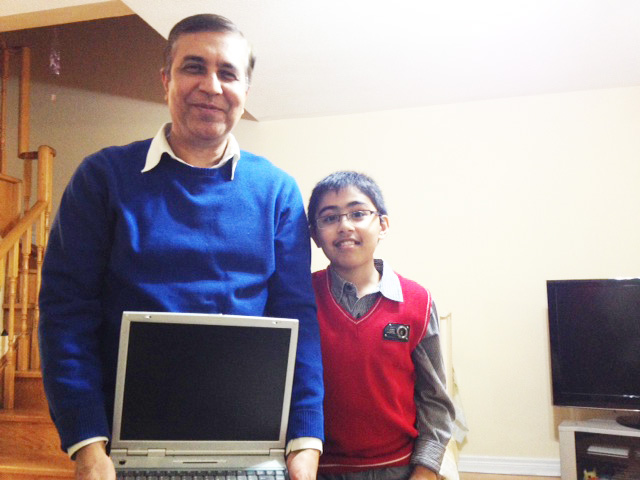
!0-year-old Tanmay seen here with his dad and teacher Puneet Bakshi. Puneet proudly shows of the laptop that Tanmay broke when he was a mere toddler.

!0-year-old Tanmay seen here with his dad and teacher Puneet Bakshi. Puneet proudly shows of the laptop that Tanmay broke when he was a mere toddler.

Sumita and Puneet work extremely hard to create opportunities for their two children.

After the word of his app got out, more than three dozen media outlets—in Canada and abroad— clamored to interview Tanmay. He’s somewhat a minor celebrity. Tanmay basks in the love of his mom, dad and big sister Tanvi, 19, who’s an inspiration to her brother and vice-versa.

“When I grow up, I want to work with computers,” says Tanmay without hesitation. “What are my hobbies? Computers. What do I speak with my classmates about? Computers. If there was one thing I could do all the time? Coding.”

Tradition! Tradition! Tradition!

Standard

starbucksLast summer, during a visit to India, I was astounded by the “Starbuckization” of the country I thought I knew intimately. Having spent more than three decades of my early life there, I had witnessed the country’s gradual economic metamorphosis in the late ‘80s and early ‘90s. Among some of the welcome changes those decades heralded was the arrival of cable television. Cable television meant goodbye to state-run propaganda. The world had finally opened to us and Indian audiences had a glut of offerings to choose from including popular U.S. television sitcoms and shows.

At this point, people’s connection with their culture remained strong because while it was one thing to watch a Hollywood heart-throb saunter in acid-washed jeans, it was next quite impossible to emulate him because branded threads weren’t available or affordable to middle-class families.

Fast forward circa 2000.

India begins to shed its century-old hand-spun ideology in exchange for North America’s glitzy ethos.  Multiplexes and malls begin to crop-up like mushrooms after monsoons.  Today, the entire country appears to be caught up in a frenzy to own, wear or sample the western way-of-life.

Mom and pop run restaurants that once served sumptuous and affordable street food have been nudged over by KFC, McDonald’s, Subway and Pizza Hut. Merchants that stocked yards of handcrafted sarees and salwars have ditched them for “imported” jeans and tops.

Now, contrast this to the emerging scenes unfolding in the leafy suburbia of Brampton and Mississauga, Ont., literally seven seas away. The dichotomy is startling.

South Asians are the largest racialized group in the province. There are some 684,070 desis that call the GTA home. The political, economic and cultural make-up of cities like Brampton is largely immigrant driven. Cruising through some neighbourhood here is like being transported through bustling bazaars of New Delhi. Even the plaza names are a replica – Janpath, Jaipur, Karol Baugh. Get my drift?

Your travels through these cities will take you through boulevards housing sprawling temples with packed parking lots. You olfactory senses will awaken and lead you towards the tantalizing smell of tandoori chicken and samosas. Your eyes will travel, feast and come to rest on individual-owned ethnic designer wear stores sporting stunning mannequins decked in rich silks, chiffon and brocades.  The exquisite jewelry accented by elaborate head and hair accessories will leave you gawking.

While the Indian culture appears to be eroding in India, it’s alive and thriving here in burbs of Toronto. Not just as evidenced in the burgeoning small and specialized business sector, but in the mindset of the families who have become keepers of customs and traditions.

So, what has been the most telling change in your perception of India? Do share.